
Silence is not Consent
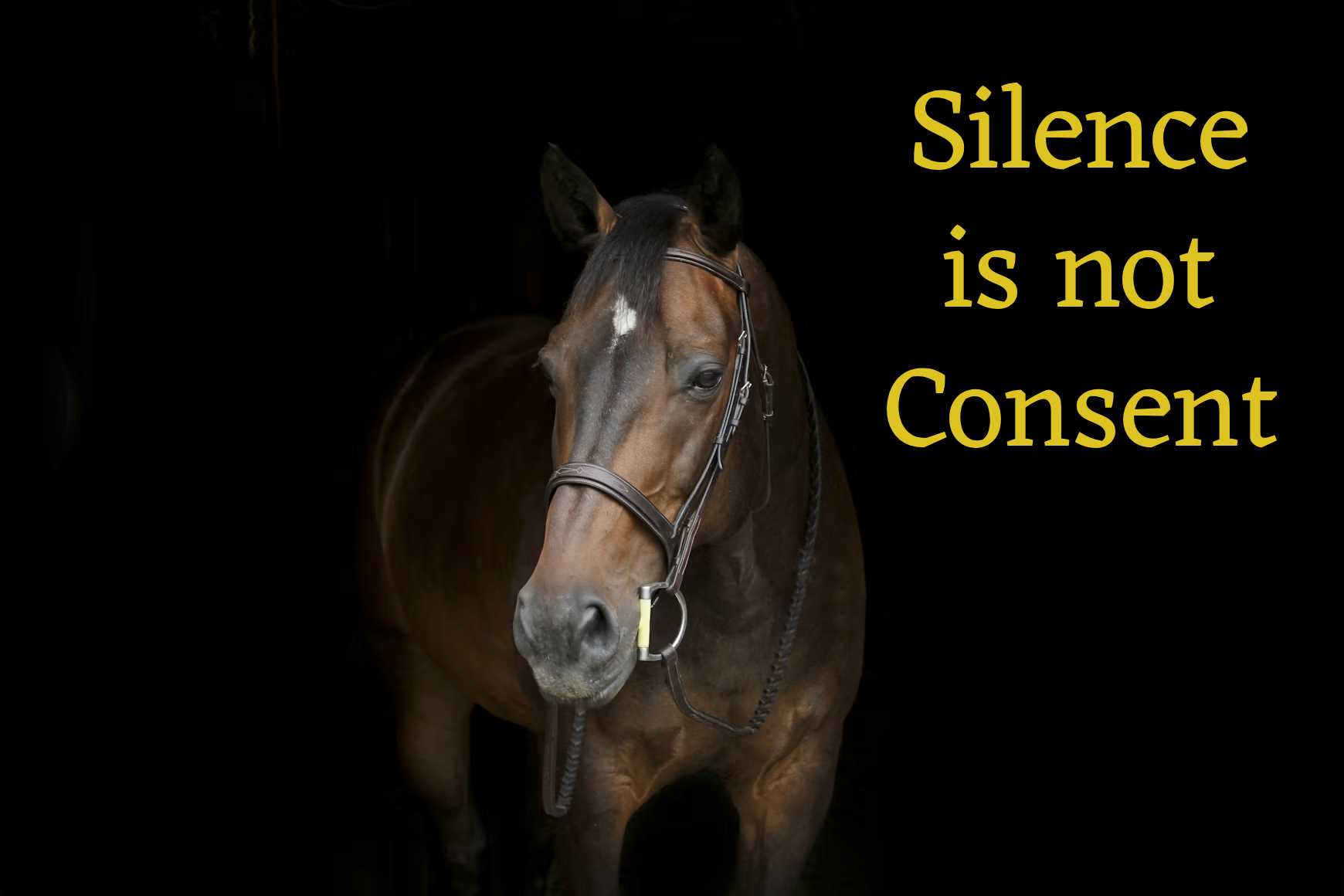
There is a quiet assumption that often shapes how humans interpret animal behaviour: if the animal does not resist, then what is happening must be acceptable. Calm is taken as agreement. Stillness is treated as permission. You can see this clearly with horses. A horse stands while being saddled, does not step away, does not object, and the moment passes without question. The absence of protest becomes proof that everything is fine. Because this interpretation is so familiar, it rarely feels like an assumption at all.
When people speak about consent between humans, the standard is higher. Consent is not defined as “they did not fight back.” It implies willingness — the presence of a real choice, and the ability to express that choice safely. If someone remains quiet because they feel pressured, trained, or unable to object, that silence would not be considered meaningful agreement. Yet when animals are involved, the standard often shifts. In riding arenas, a horse may complete every movement asked of them. In zoological settings, an animal may approach on cue and perform expected behaviours. Performance becomes visible and measurable. Willingness is harder to see.
Horses are widely recognized as expressive animals. They can refuse, evade, or show discomfort when they feel able to do so. At the same time, they are highly adaptable and capable of learning complex routines. Over repeated interactions, they learn which behaviours lead to release or reward, and which do not. The absence of protest does not automatically indicate comfort; it may indicate learning. From a distance, that learning can resemble discipline or partnership. The distinction between learned compliance and genuine willingness, however, is not always visible unless someone is actively looking for it.
Interpreting compliance as agreement is often the easiest path. It allows systems to function smoothly. If the horse stands quietly, the ride continues. If the animal performs the behaviour that is asked, the schedule stays intact and expectations are met. Environments built around animal care — private barns, competitive arenas, zoological institutions — rely on observable behaviour. Questioning whether behaviour reflects willingness rather than adaptation introduces complexity. It requires slower observation and a tolerance for uncertainty. That complexity is not malicious, but it can be inconvenient.
When silence is mistaken for willingness, the consequences are rarely dramatic. The shift is gradual. The animal’s individual signals can become secondary to the role they are expected to fulfil. Their communication may grow subtler over time, not because they have nothing to express, but because experience has taught them that certain expressions change little. Even in structured, professional settings designed around welfare, this narrowing of interpretation can occur without anyone intending it.
Not all human intervention carries the same weight. There are situations where humans act on behalf of an animal because welfare depends on it — veterinary care is an obvious example. There are also situations where intervention serves human goals: performance, breeding, aesthetics, preference, tradition. As the level of control or intrusion increases, so should the level of justification. Desire alone is rarely a sufficient justification when autonomy is involved.
Applying this standard consistently is not simple. Most human–animal relationships exist within systems that reward efficiency and visible results. Recognizing that does not imply malice; it simply acknowledges that interpretation is shaped by context.
Animals do not use human language, yet they are far from voiceless. They communicate through posture, tension, hesitation, attention, and engagement. The responsibility is not on them to protest loudly enough to be heard; it rests on humans to interpret more carefully than habit may encourage. Humans have become skilled at recognizing resistance. The more demanding task — and perhaps the more honest one — is learning to recognize willingness. If the goal is partnership rather than performance, then “no protest” may no longer be a high enough standard.
Article written by Mares² (March 2026)
Questions, comments or concerns? Check out our Matrix server! https://join.zooey.pub


