Zoo Census 2025
I really love data. Yes, I know I'm a nerd, but I mean, come on. There's so much that we can learn from numbers. Statistics are at the heart of literally everything. Which is why I'm extremely excited to announce that we've finally got the data from the 2024 Zoo Census that was run a while back. TECHNICALLY speaking this data is more than a year old at this point, but hey, I still think that it's interesting to look at. Especially since the whole idea of a census isn't just to run it once, but to run it again and again to track the ways that populations change. But more on that later. More so, I think learning about the kinds of people in the community helps us better see what audiences we should be trying to cater to, as well as where we might be missing representation and where we should focus on growing. If you just want the full report, it'll be at the bottom, but I want to break down the numbers a bit, just to show how someone who likes numbers takes this kind of data.
First of all, there were 195 participants for this. Okay numbers, but honestly I think we could do much better.
The first we looked at the age distribution in the community. This is a great first question because I think it really helps to highlight something that's going to be really important throughout the analysis of this data.
PART 1: DEMOGRAPHICS
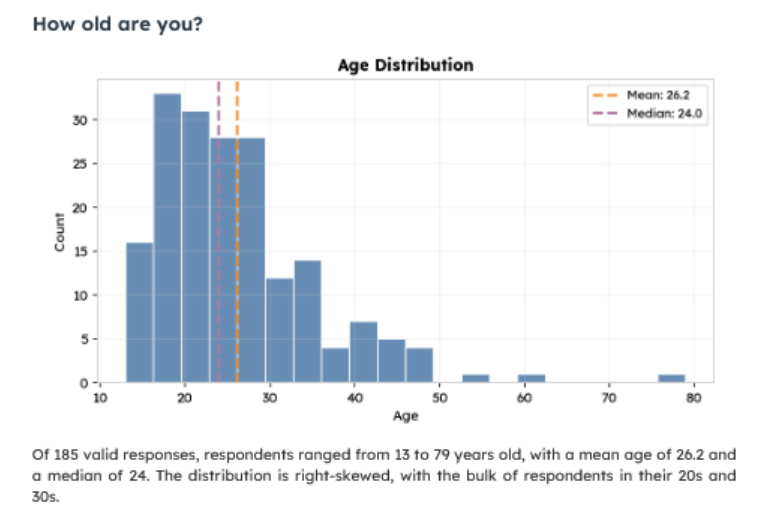
We found that the median age of zoos replied to this survey 24. But, to be clear, that does not mean that most zoophiles are 24. This is a statistical limitation. Namely, the method. This survey was sent out to as many channels as we could, but our audience is most of the replies, and that tends to be people who are very digitally connected. And, young people definitely tend to be the most digitally connected. I think there's a huge portion of older zoos that just never saw this study, and because of that we don't have their perspective to the other questions either. So, already it's fair to say that this is more of a census of our zoo community more than zoos in general.
That said, that's still good to know. With this data, we have a good sense of the way to speak to our audience. The refrences to make, the terms to use. It also shows the relative youth of this wave of the zoo movement as a whole. We don't really have a lot of "zoo elders", who have long term experience doing this. Sometimes it feels like we're just making it up as we go here, and that would make sense as we don't have many older folks that can help guide us.
Anyway, speaking of a lack of representation..
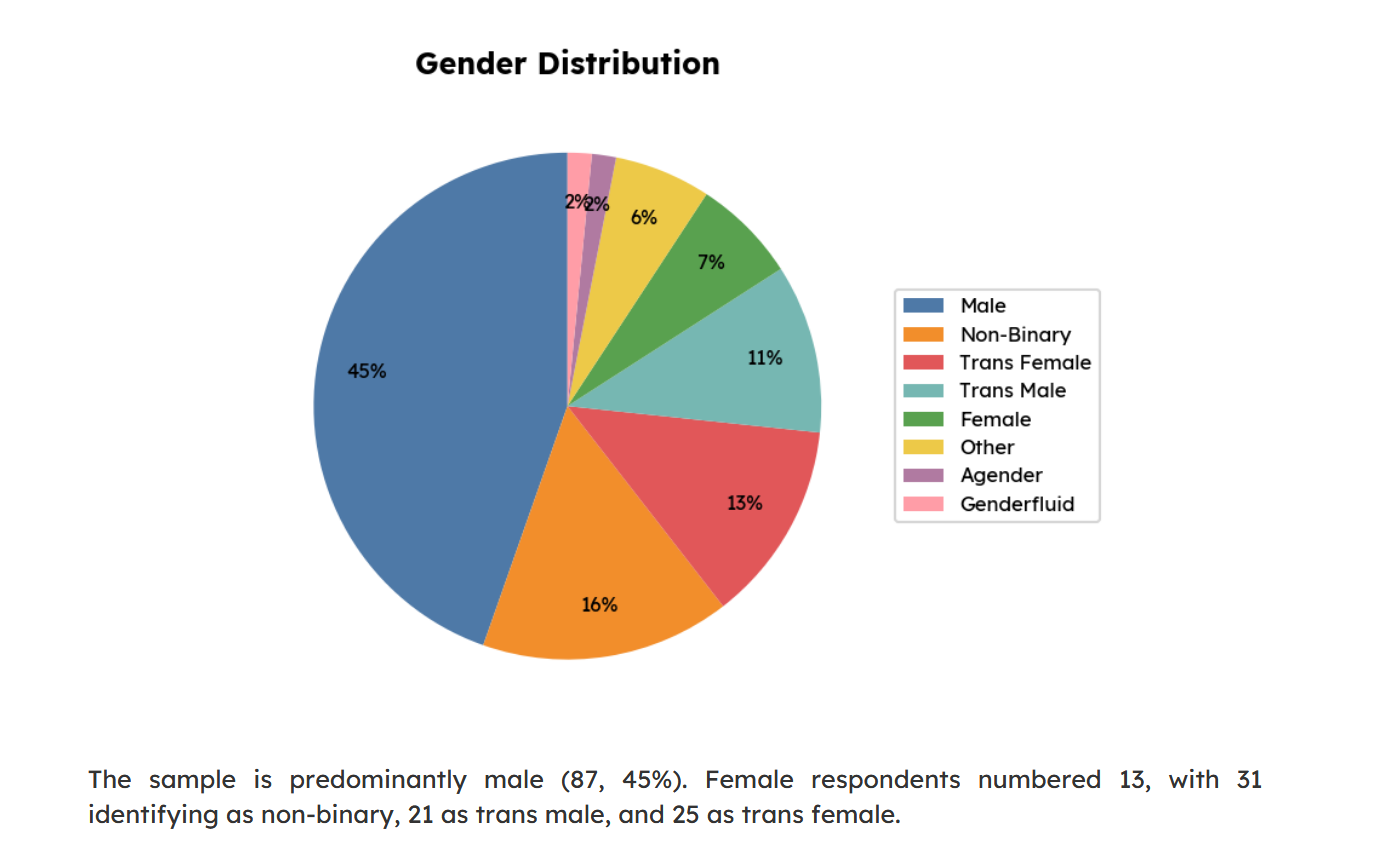
On one hand, it's cool to see that cis males make up less than 50% of the community, especially since we have a 50% non-cis population, which if you didn't know is VERY high based on general averages. But there's one place where we're really missing a lot of folks, and that's cis females. I know there are a number out there, and I think were we to do this again today, that number might be higher, but also wow it's crazy to see that that's lower than trans male, trans female, and non-binary. You do tend to see lower female representation in a lot of online spaces, but it sure goes to show that the white women and dogs stereotype doesn't really hit. Either that, or the white women with dogs just did not show up for this survey. This is somewhat concerning as I do want to make sure that we can properly represent that perspective, and it makes me wonder if as a community we're doing something that makes us less appealing to that demographic, that's something we can work on in the future to try and get more folks in that category participating in the zoo community.
I don't want to go over literally every data point, so just to sum up a couple to speed things along, the zoo community as reported in data is EXTREMELY white. 78% of respondnts. This is another trend you somewhat expect to see in online spaces, and also if you've been to a furry convention you know that shit tends to be whiter than mayo, but I don't think there's anything intrinsic to the caucasian experience that would someone being more likely to be a zoo. There's actually some really interesting studies looking at queerness in cultures and they find that in general people who face other kinds of oppression tend to not be as likely to identify themselves with other struggles.
could also be biased by the fact that the vast majority of the respondnts were American as well, with #2 and #3 being the UK and Canada. That's something I would DEFINITELY like to try and remedy, because I know there are a billion zoos out there in Europe and South America, and likely all around the world, but
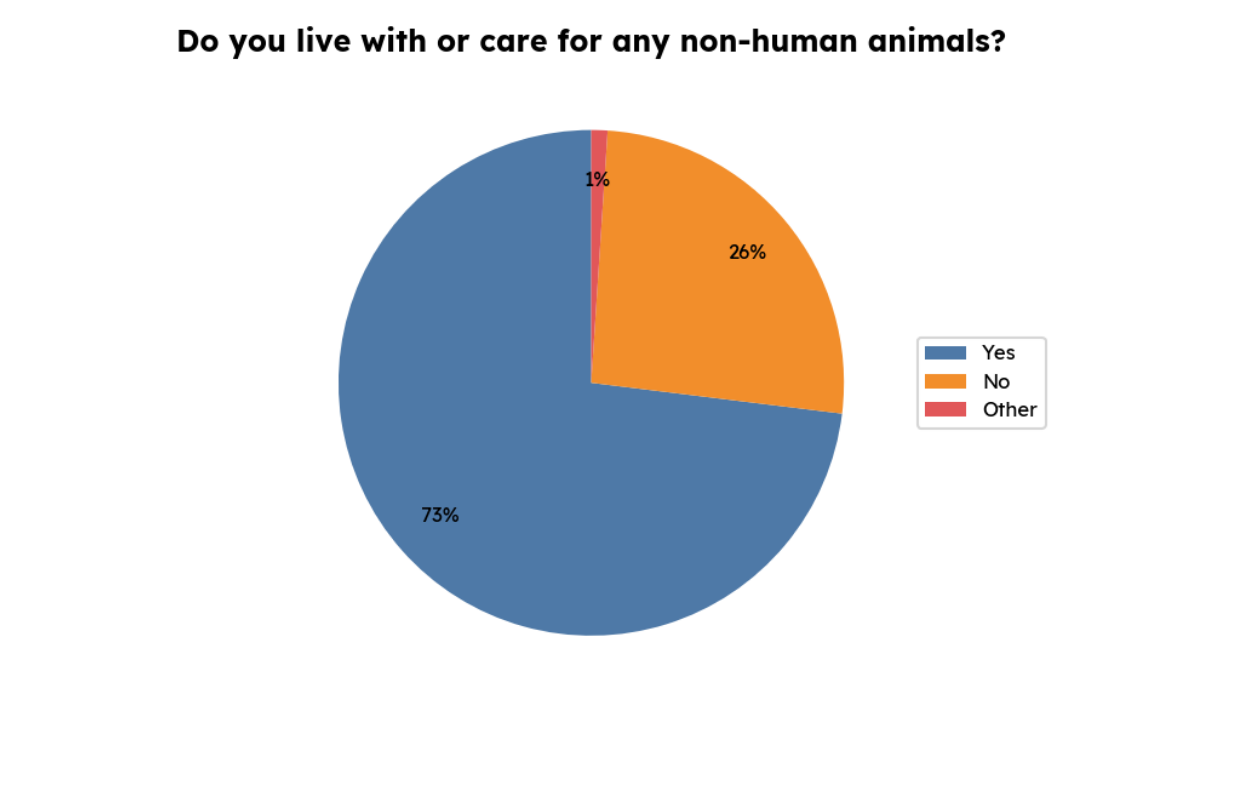
Another piece of data that I found really interesting is that apparently 73% of respondnts live with an animal. This is actually higher than I was expecting. Being responsible for an animal is a lot of effort and money, and just based off my experience it's more like 50/50. I do think this number would be very different if we looked exclusively at people don't live with family, but we didn't do that. It does make me wonder about whether or not the presence of a "family dog" changes how likely someone ends up identifying as a zoo later in life, but that's a study for the far future. For now, it's just good knowing that if and when we do animal care articles there's definitely value to that.
Also, to no surprise, the actual animals people live with tended to go along with what you'd expect. 46% live with a dog, 34% live with a cat, and interestingly reptiles came in third at 7%. What this tells me is that we should really be talking to the feline lovers out there, because there sure are a lot of cats in zoo households. I don't really know that much about cats personally, but if you do and you want to write in about cat tips or just other feline facts there's apparently an audience for it!
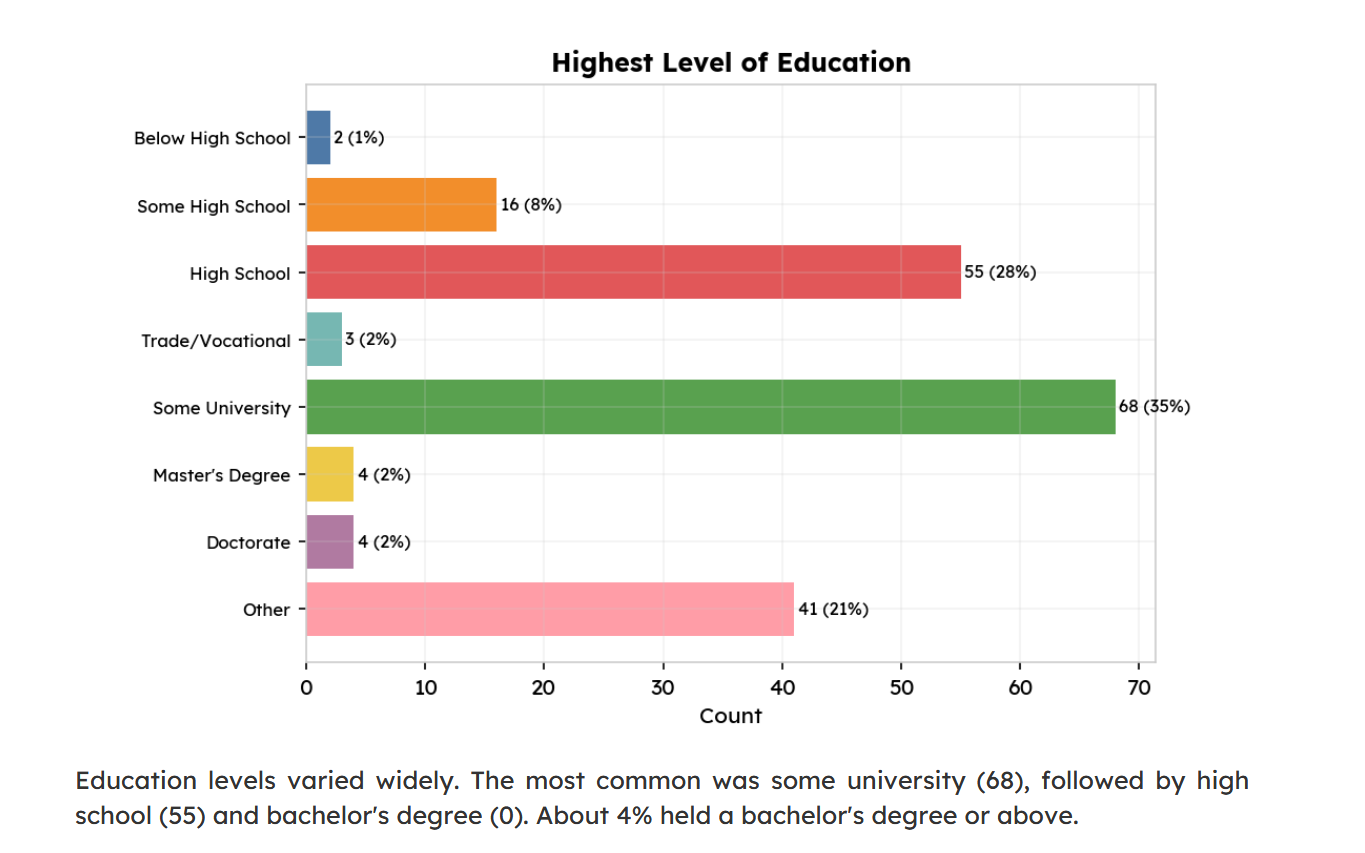
We also asked about the education level of people surveyed, and found that there are quite a few well educated folks the respondnts. Only 9% of people reported that they didn't finish high school, which could be people still enrolled in that, while a whopping 63% had education of some kind past high school level, with 35% having some university, 4% having masters and doctorates, and a bunch more having some vocational or trade school. This doesn't shock me, but it is cool to have data on the fact that a lot of zoos are pursuing higher education. When you look at our age demographics, it also checks out that a lot of people would still be enrolled in university. If we do this for a number of years, I would expect that the number that have big fancy degrees would go up, both as we get more reach and also as the University folks graduate.
Along the same lines, we asked about people's income levels, and they tracked with the rest of the data. Everyone is struggling right now, but in general we saw a lot of zoos self report as being low-median level. That makes sense with education level and age.
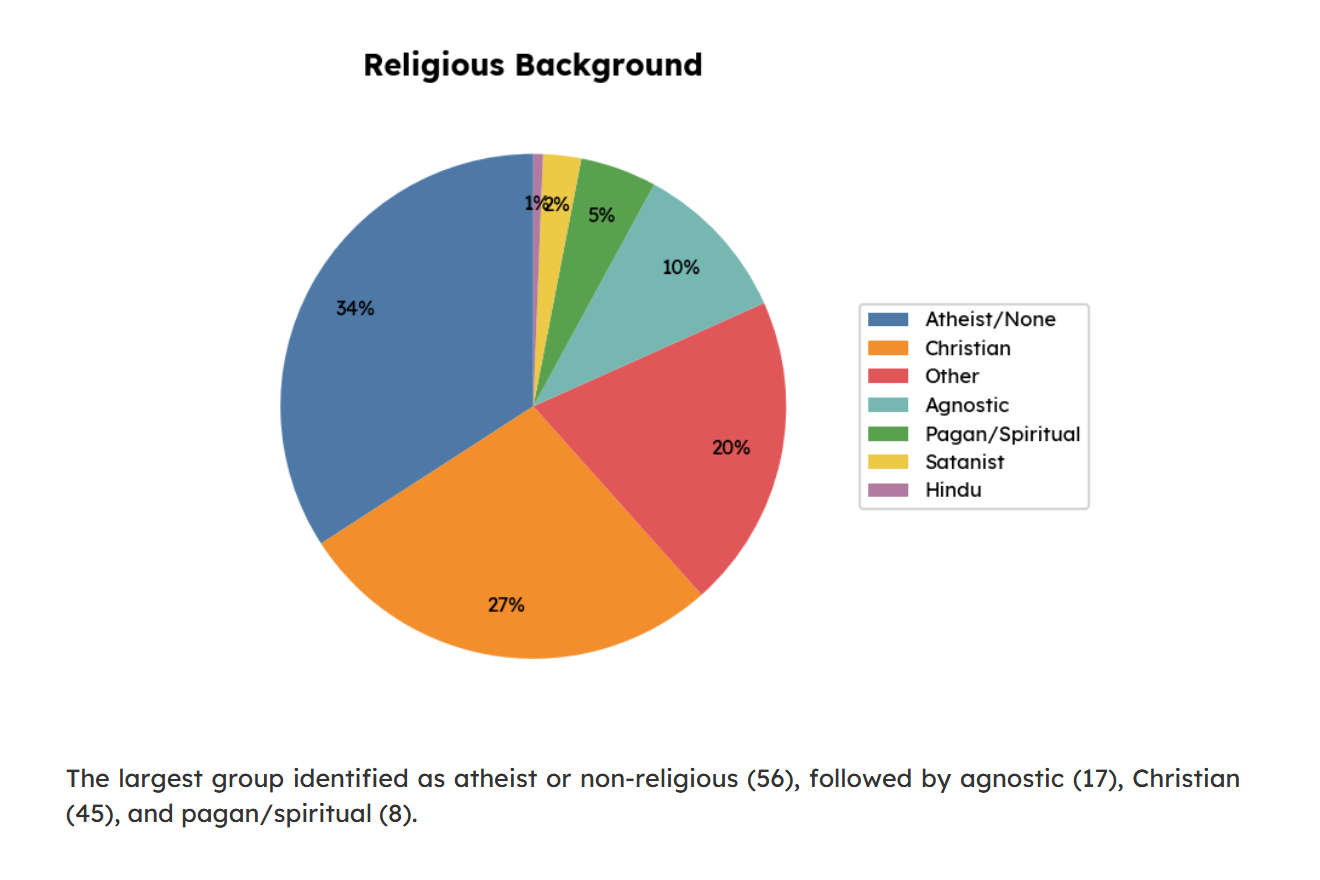
This one actually surprised me a lot. The biggest religious category within the data was Atheist, which tracks with the age demographics and the shrinking religious population, but I did not expect 27% of respondnts to identify as Christian. Maybe I should talk less about how much I think god sucks in these articles! Which makes sense considering there aren't a ton of religions out there that love zoophilia I personally thought we'd have more pagans and Wiccans representing, but apparently not!
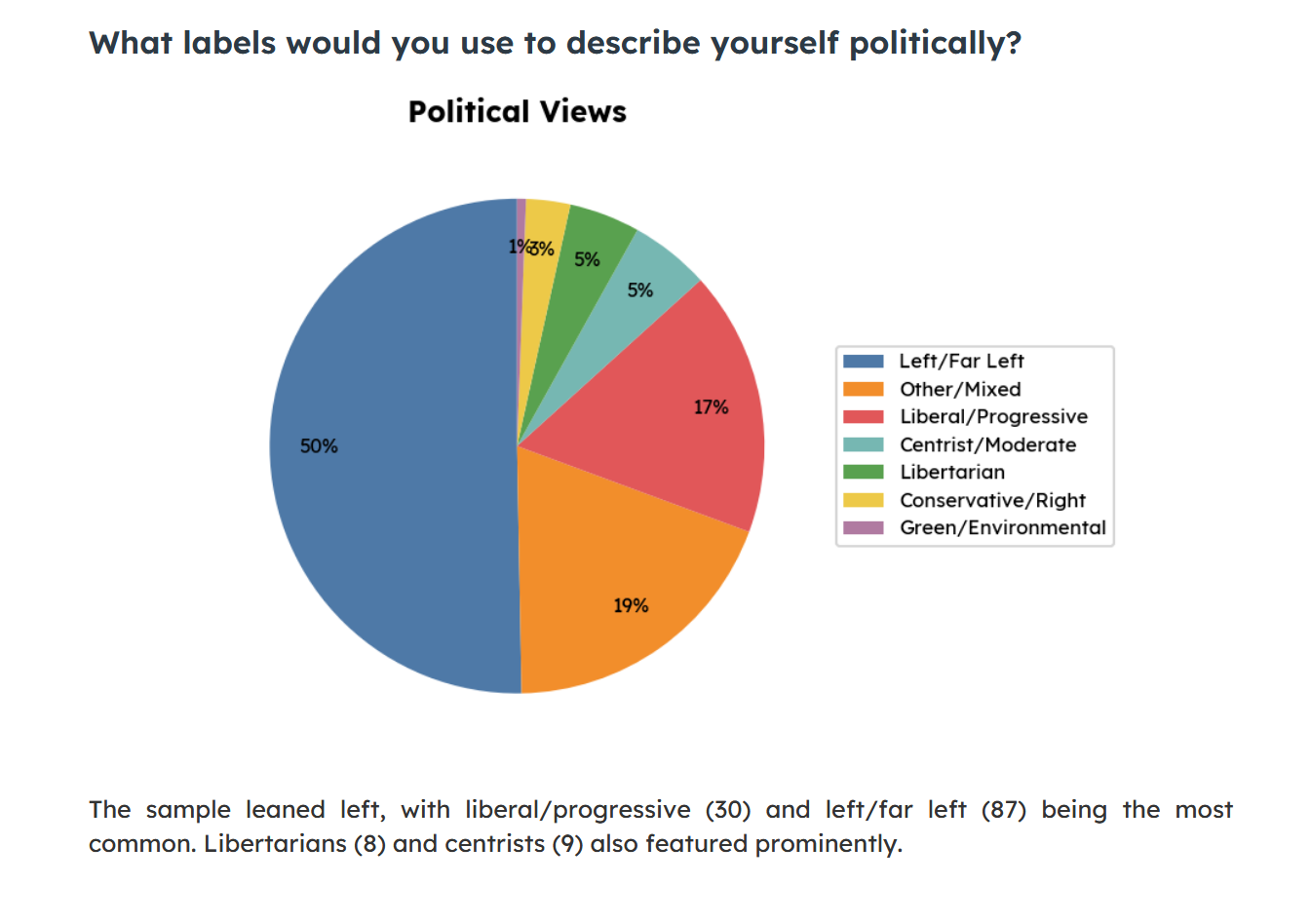
Political beliefs track pretty well too. Politics are fairly contentious in the world right now, but 50% of the respondnts identified as Left, 17% identifying as liberals. Only 3% of people identified specifically as conservative, which makes sense. It's somewhat hypocritical to identify as queer while supporting the party that hates queer people.
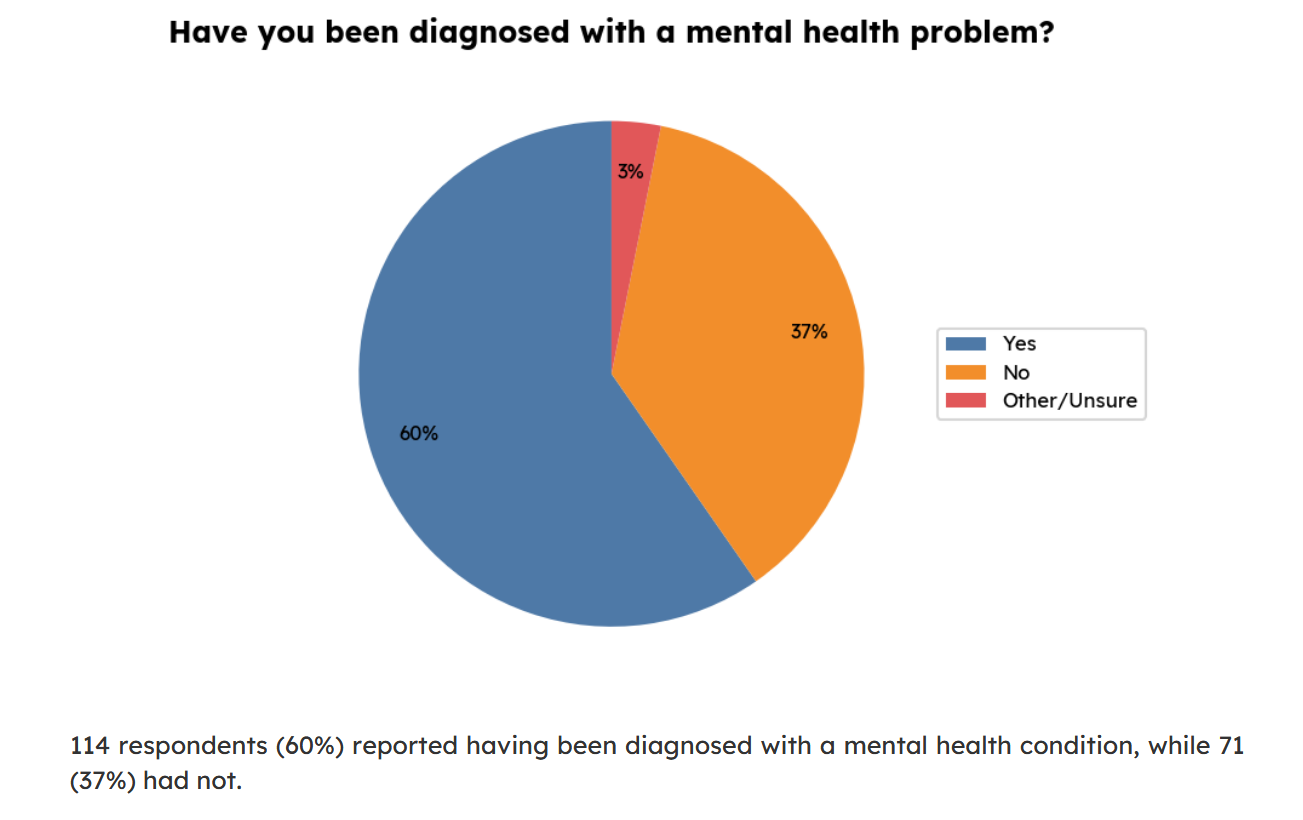
Apparently zoos really are mentally ill! That said, this actually isn't too far off the reported numbers for the general population. We live in a time that's very aware of mental illness and sees it very much like a spectrum, so while 60% of respondnts identified as being diagnosed with a mental health problem, that doesn't really give us that much data. Depression was the most reported, with ADHD being second, and Anxiety third.
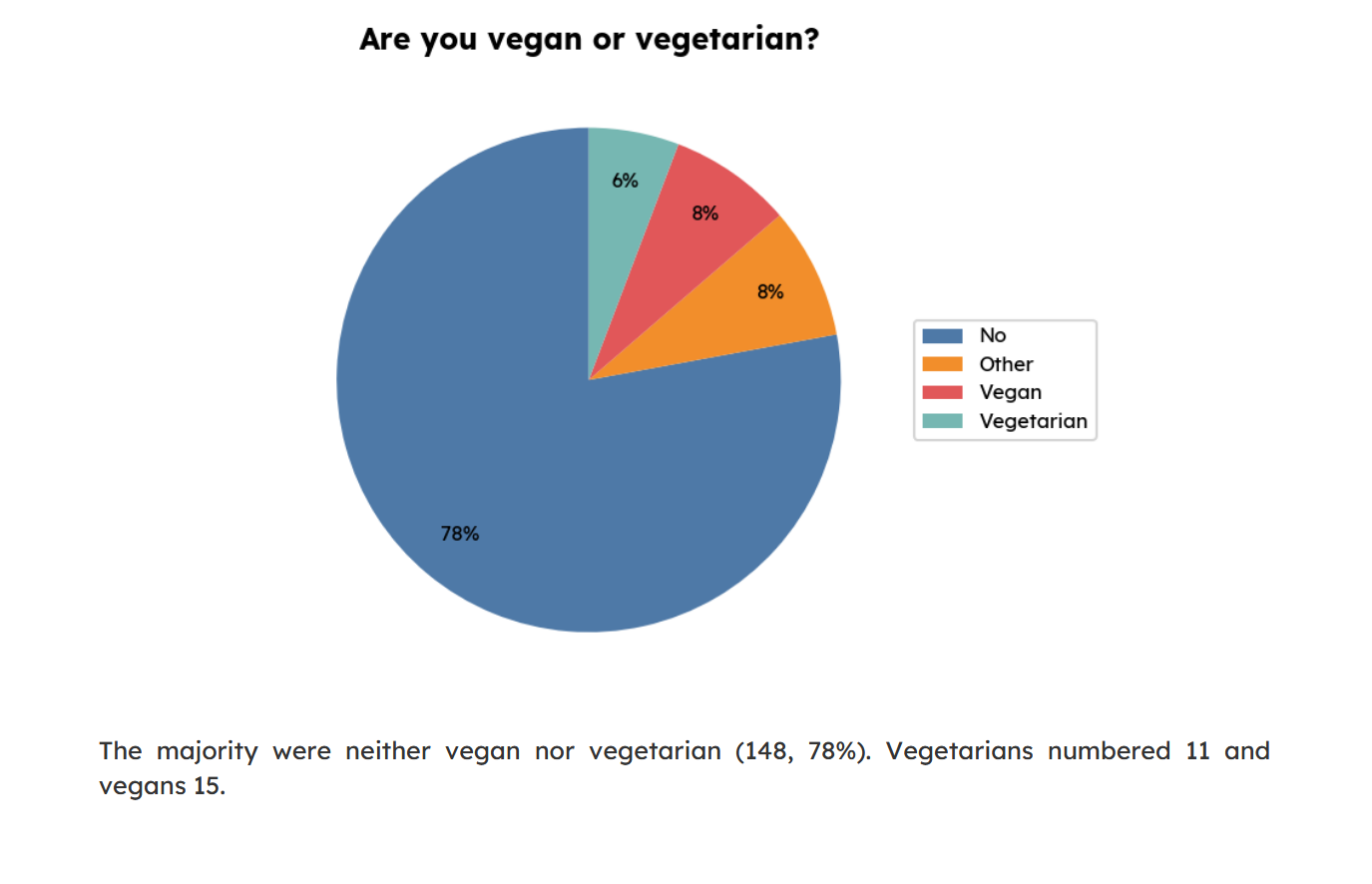
We also asked about the amount of people that are vegan/vegetarian. I was a little shocked to see more people were vegan than vegetarian, considering how much harder being vegan is 14% that's significantly higher than the general population. There are also 8% of people who said they were other. This could be things like pescatarian or show some level of conciousness to the idea of wanting to be vegan. Which is cool. I would love for the percentage of vegetarians and vegans go up more and more as we do this census, but for right now it is good knowing that zoos are more aware of the harm from factory farming than the general population.
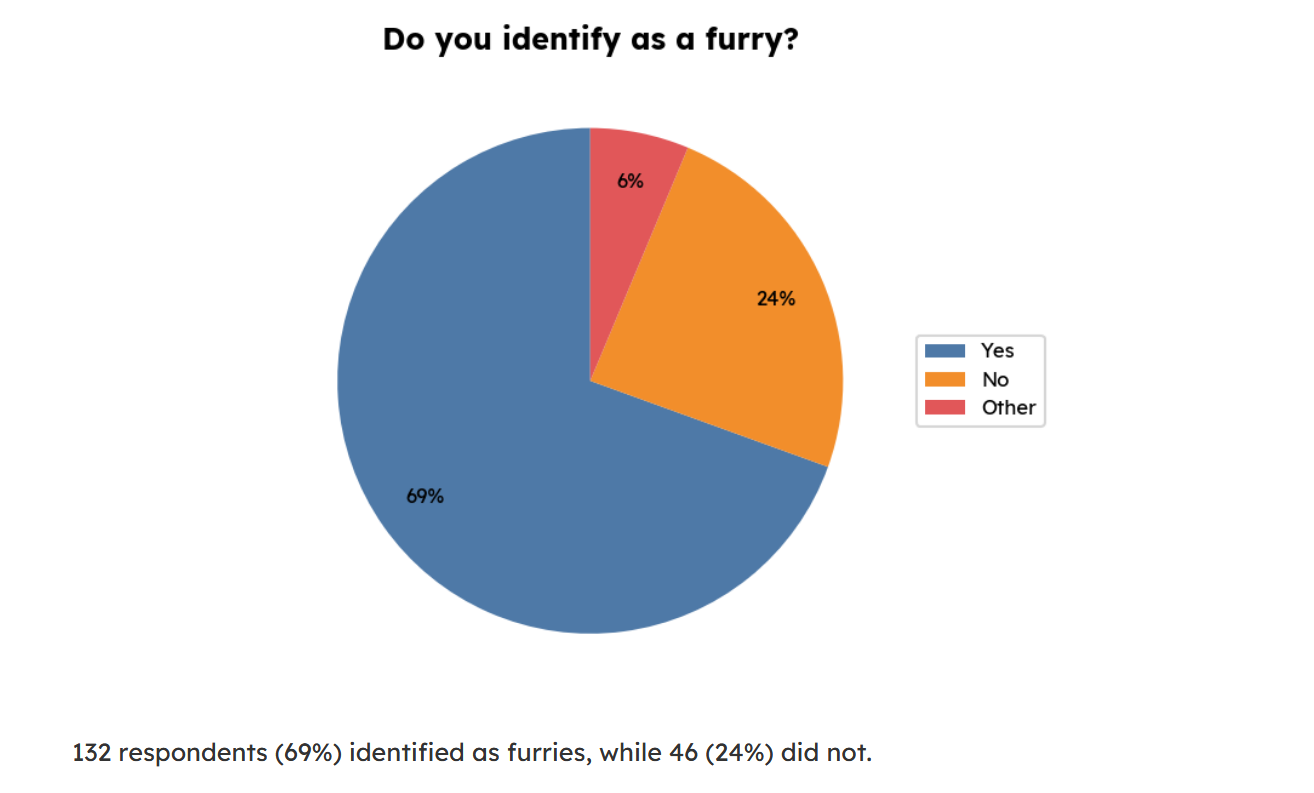
Skipping over a few, we also asked whether or not respondnts were furries. 69% (nice) said they were furries, with 24% saying no, and the rest saying "other". We've always known there's a pretty significant overlap with the furry fandom, but it's nice to have the data to show that our furry overlap articles are the majority of our audience. This is a number I actually expect to go down over time as this census gets bigger as well. Right now, I think the online zoo community is much more tied to the furry fandom, but I think older folks and people that are less online are going to be less likely to be furries
here was more than a 50% show from people that were therians, or therian adjacent. 8% of respondnts identified as therians, with 9% identifying as otherkin, and 15% othernly 48% of respondnts identified with their born species, which WOW I knew there were a lot of therians, but that's a ton more than I was thinking. We should really have some more therianism articles, or content speaking to that audience!
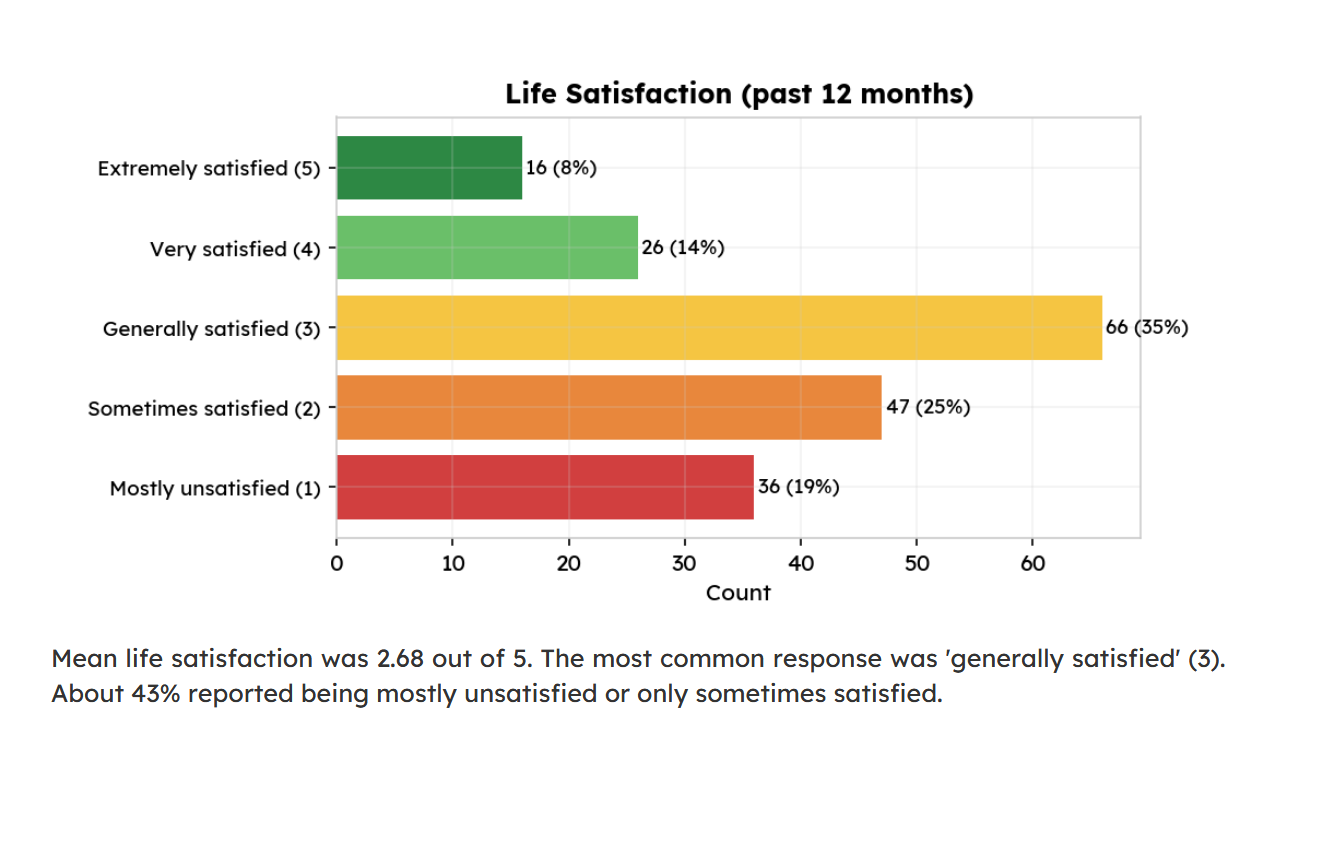
This one was really interesting to see. We asked about whether or not people were satisfied with their lives. On a 1-5 scale, the majority put three, so right in the middle. The mean life satisfaction was 2.68, so really really just ekeing out the average there. That seems really low, but also it's actually not that far off from the global averages! This number tends to swing a lot depending on who's asking and the areas that they're looking at, but best guesses put the number at about 2.6 to 2.8, so we're right in there. Considering the amount of oppression that zoos face, this thing. It shows that as much as it can suck to be a zoo, we're . And, it really highlights the way that everyone is struggling right now. It's a tough time in the world I'd be really curious to see if things start trending in a more positive direction whether that would make zoo numbers also go up at the same rate, or if then we would start to see lag back we have more time and energy to devote to problems might not
PART 2 - ATTRACTION
Alright, this is getting very long, and I'm on my fifth coffee, so I'm going to start speeding through this a bit more.
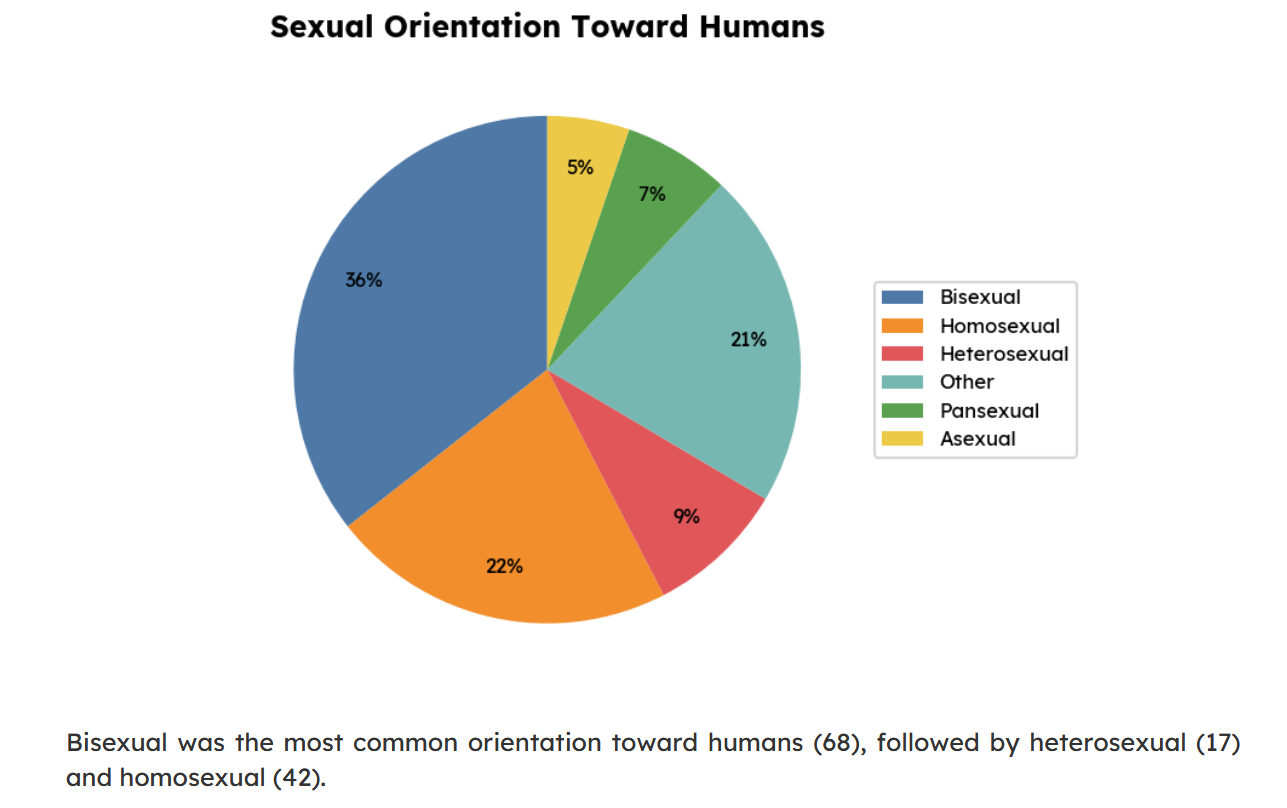
We start this section off by looking at the amount of zoos that are attracted to humans, and what their sexuality towards them is. And what we see is that there is an OVERWHELMING bisexual presence in the community. As a bisexual myself, this is really cool to see, and I think it also adds to another theory that I have about sexuality. Everyone says sexuality is a spectrum, but I think that like most spectrums most people do probably fall in the middle rather than the extremes. I personally think that very few people are fully 100% either "straight" or "gay", and in spaces with more sexual liberation (you see this with furries as well), bisexuality goes WAY up because people are more willing to explore and try things, without fear of the backlash that might come from being discovered that your "Straightness" isn't air tight. In fact, only 9% of respondnts ended up identifying as straight!
Another huge group here is people that just aren't attracted to humans at all! I very much wish that we made a better distinction between people that are just asexual or people who just aren't into humans which is fairly high!
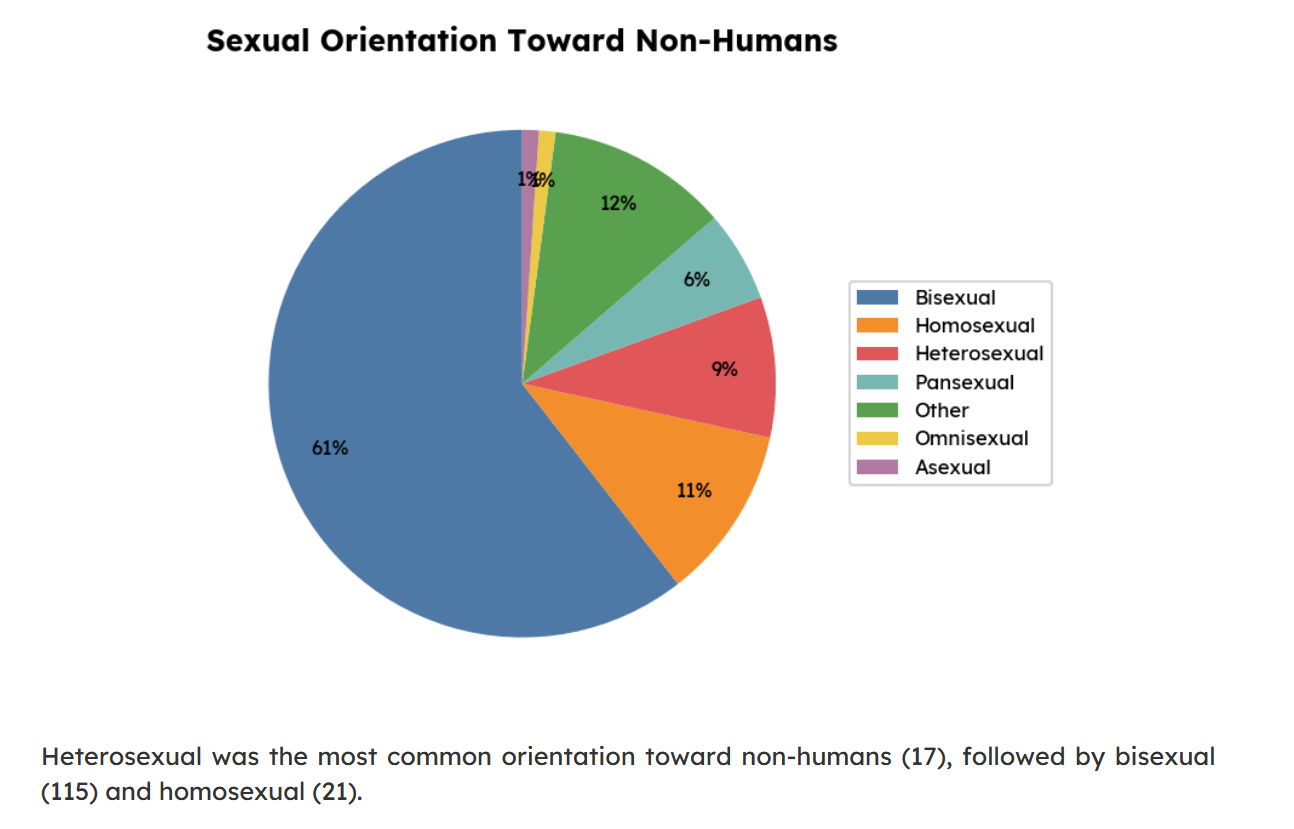
When it comes to people's attractions to animals, the numbers. 61% of respondnts identified as bisexual, with another decent chunk identifying as pansexual. Here, the bisexual sweep is even more prevelant. I think this is really interesting, because I think it opens the door to a question of whether or not animal gender matters as much to zoos as just the fact that their partner is an animal. The thing that people are attracted to might not necessarily be knots or cookies as much as it is animals in general, which is really interesting, and something that I'd love to explore in further studies.
We also asked whether or not people are zoo exclusive. Of our respondnts, 75% said that they're still attracted to humans as well, with 18% saying they're fully exclusive, and the rest saying they're somewhere in the middle. That's around what we were expecting I think. There definitely are plenty of zoo exclusives out there, I know a bunch. But also, if you're looking to the zoo community to find a two legged romantic partner it's not like you're going to be totally out of luck here.
In fact, we asked if people are romantically zoo exclusive explicitly, and the number there was 77% were open to humans, so there's some people who are sexually exclusive, but are okay with a human companion in their lives, making a very funny parallel of the typical human animal relationship in a way that makes me giggle.
When it comes to what species zoos are attracted to, I don't think it's even worth copying the graph. Canines absolutely take the top spot with 57% of zoos attracted to them primarily, and then humans take the second spot, and then horses took third. So, essentially, a lot of people that are primarily attracted to dogs are also attracted to horses, but wouldn't consider them their main attraction. Neat! Cats, dolphins, and deer also make a strong showing.
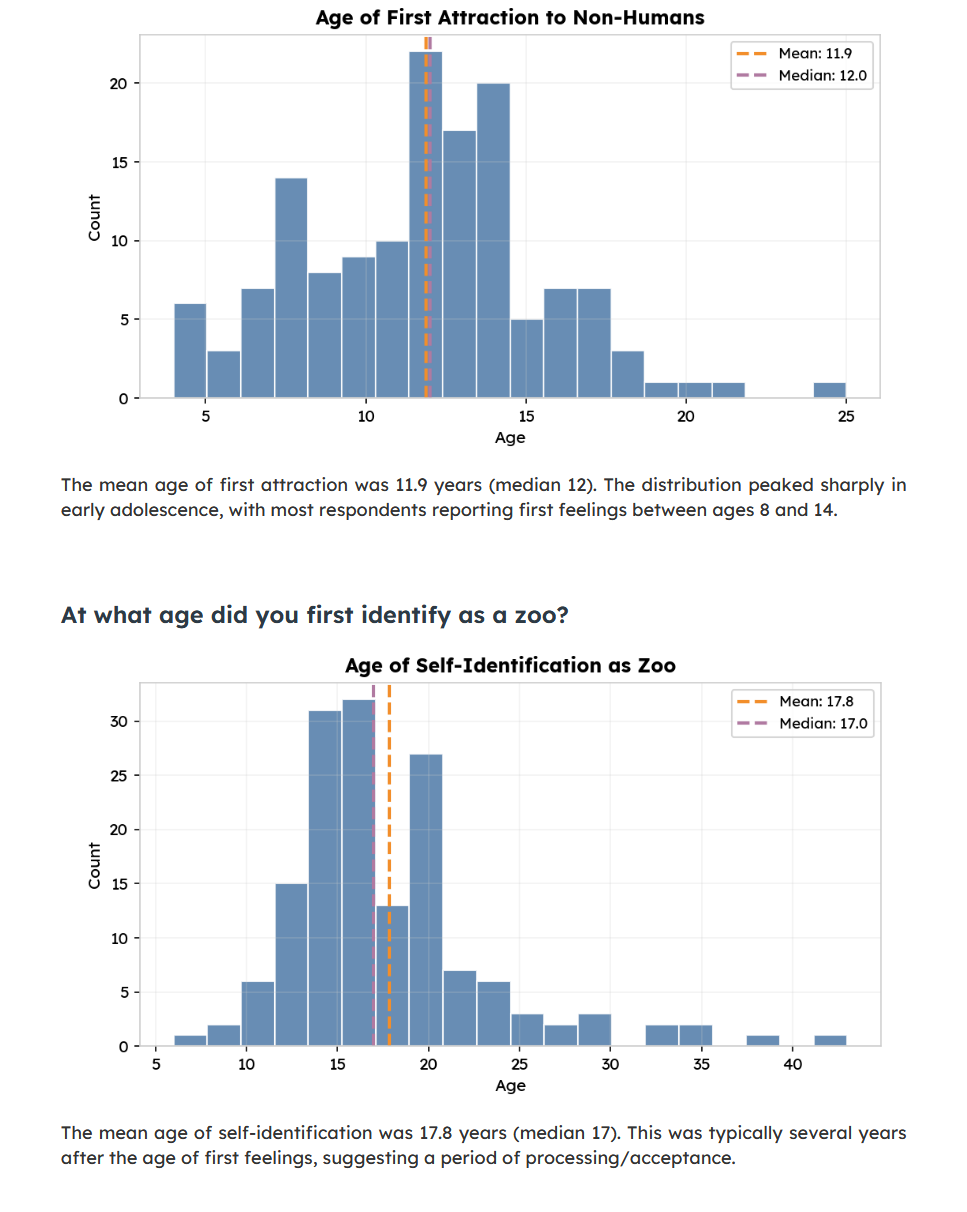
Okay, this one is really cool. We asked what age people first realized they were a zoo, and then also asked them when they first actually identified with the label, and the results are EXTREMELY telling about the zoo pipeline. Generally speaking, on average people first experience attraction to animals around the age of 12. This is generally consistent with the way that most sexuality gets expressed, if not a little bit later. 12 is right near the start of puberty when people generally start feeling these kinds of things. Some people are earlier, some are later, but that tends to be around right. However, the median self identification of zoo as a term is at 17. Which means, on average people have about 5 years between when they realize they have an animal attraction, and when they identify with the term "zoophile" I think there's two possible reasons for this, and both are neat.
On one hand, I think it's hard to label yourself with a term you don't know exists. Maybe when you're of that age, you've just never heard of zoophilia or zoosexuality, and so you just don't have something to use in lieu of that. That could absolutely push some people's usage of the label back until they come across it in the wild, likely when they're more sexually connected online and find it. But, the other thing I feel is pretty common is a negative reaction to the realization of your attraction, and a push back against it. We talk a ton about the anti to zoo pipeline, and I think this could be very good evidence of that, where people realize they're attracted to animals, and then create a whole personality around how much they think people attracted to animals suck. But, as you get older and you have to confront your own feelings more and more you start to actually talk with zoos, make friends, and accept your attraction. Considering the biggest spikes are from 17 to 20 I think that makes a ton of sense. It's when people have to start facing the real world, and that can include facing yourself.
Speaking of sex with animals, of the people that responded, about 58% report having some amount of sexual contact with animals. So, it's something that's theoretically aspirational to a lot of people, who haven't had the chance to have an animal partner. That's another little fact nugget I'm keeping in my head when thinking about content for the magazine. Maybe it would be worth talking to that audience more. I think as of the major writers here have had relationships with animals it's easy to miss that point of view.
PART 3 - THE COMMUNITY
Y'all know I'm excited about this part. To kick things off, we asked whether or not people consider themselves a member of the "Zoo community". Considering we expected this to be highnd it came back at 74%, so right in line with expectations. I would love to get more people who say "no" to this question, not because I don't want to see the community grow but because those are people that we don't know about as they don't necessarily participate with zoo community things. If ~5% of are attracted to animals (more on that in an upcoming article (this is a teaser as a thank you for making it this far fellow nerd)), then there are a WHOLE lot of zoos that are not in the zoo community.
People also said they discovered the community around 17-19 mostly, which actually makes a lot of sense with the point I was making in the last section. You need to know about a label to use it.
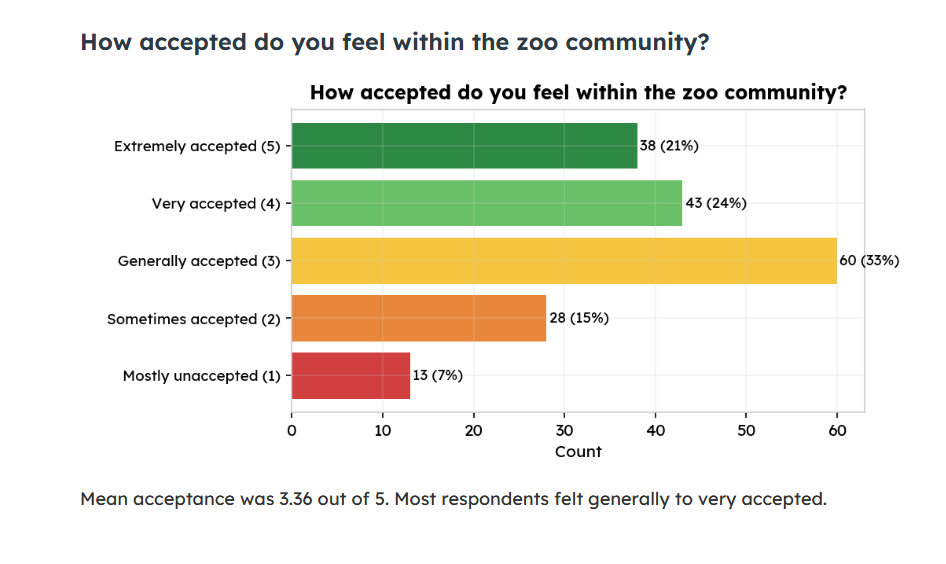
Okay, let's get into something weird. We asked how accepted people felt within the community, and while the result was definitely more positive than negative, you might expect that the numbers would be even higher. I mean, a community of people that love animals is already niche in its own right. Only 21% of people said they felt "Extremely Accepted", with 33% saying they felt "Generally Accepted", and 22% said they felt less than average accepted. I think some of the reasoning for this result is probably the issue of paraphilia within the community. There tends to be a pretty large split between pro and anti para folks, and discussions like that can be very alienating to people who really care about it. To be clear, I think it's a good thing that some people don't feel welcome in the community. As much as I think it's great to have people here, I don't think we want people like nazis, bigots, or abusers, so some amount of 1s here is healthy, but I would like to turn more of those 3/5s and 4/5s into 5/5s.
Anyway, if you're a part of the community, you probably know that we have a lot of lurkers who don't really participate, but just hang out. And that's cool, we love our lurkers! But, now we have the numbers to see just how many there are. 26% of respondnts said they were Mostly Inactive in the community, but they got this survey, so clearly they're connected in some capacity. 25% said they were "Sometimes Active", and 28% said they were "Generally active". Only 20% of people put themselves in the top two categories, so a lot of people aren't actually spending a ton of their time in community spaces. On one hand, that's fine, live your life. But, people spending time consuming zoo content, engaging in zoo spaces, and just in general being part of the community is really helpful for the movement o that's something that I would really like to try and address in the future. If this is you, shoot me a DM! What could we do to make community spaces more appealing to you?
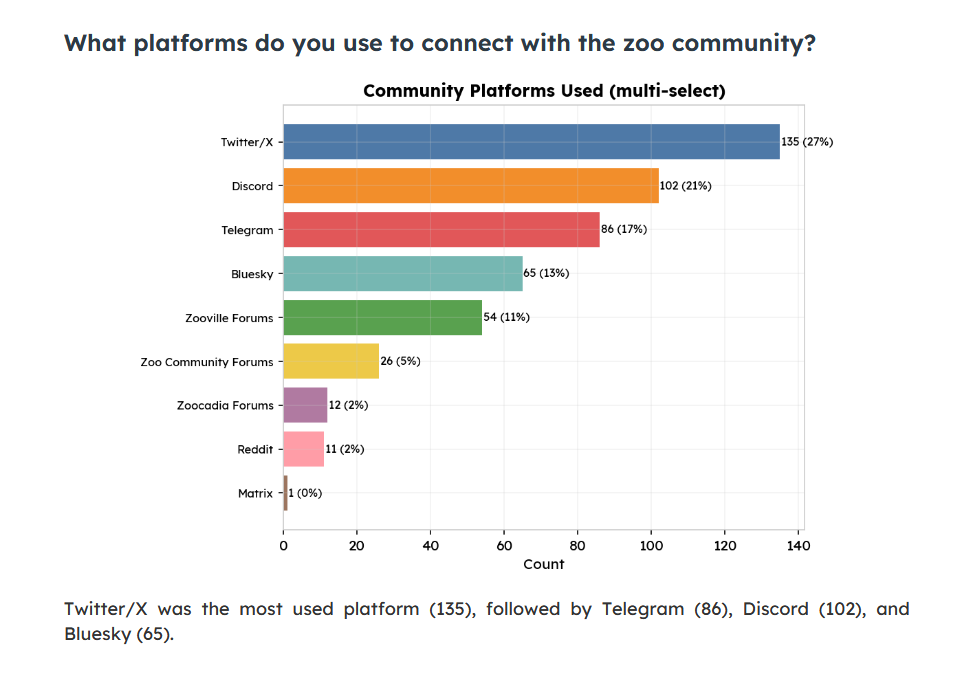
We asked what platforms people use to connect with the zoo community, and I think this dates this census more than anything else. But, it does also go to prove a point that I try to make frequently. The highest bracket of respondnts said that they use witter to engage with the community. I know witter is a hellscape, but it's also by far the most visible way that we can exist in a public setting. Keeping some level of zoo presence on there is the best funnel we have for then getting people to try out other spaces they wouldn't come across naturally.
In a gunshot to the heart, the second biggest answer is Discord. I'm guessing that has a lot to do with the now deceased ZDPD. There are definitely still zoos on there, but it's a lot less, and with the new rules they're putting in place with ID, I'm expecting that number to basically hit the floor. There's also a pretty big percentage that said Bluesky, which is extremely anti-zoo nowadays, and about 11% of respondnts use Zooville. Only one single person reported using Matrix, which I hope is going to be a lot bigger the next time we do this. Honestly, I REALLY want to do this again soon because I think all of have changed extremely dramatically. More and more zoos have been seprating into smaller groups, and it'll be interesting to see how that's shaken out since this was asked.
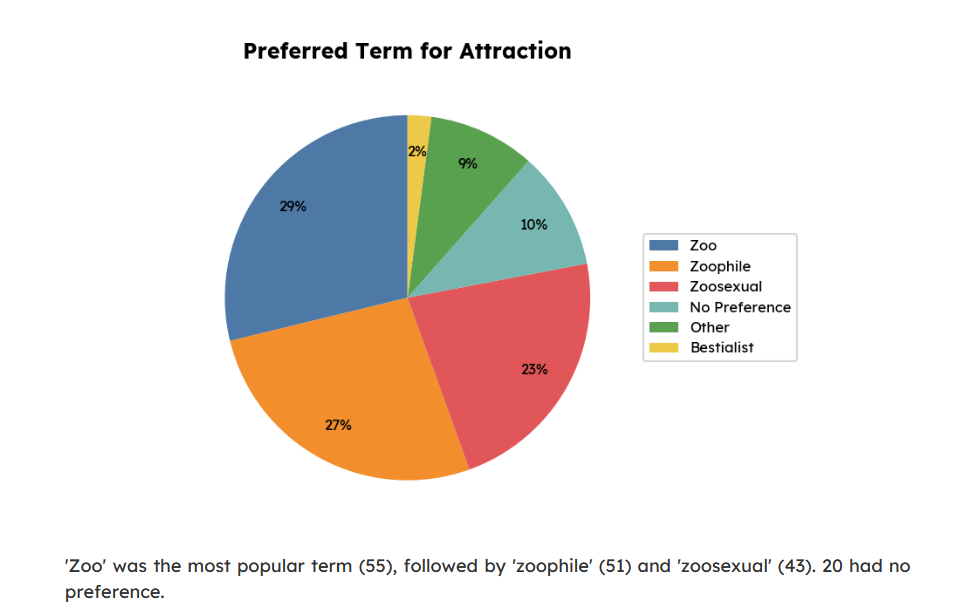
This one really took me by surprise to be honest. I'm not shocked that just "zoo" was the #1 choice for label. It's fun, it's catchy, it's trendy. But the fact that so many people prefer "Zoophile" to "Zoosexual" was shocking. I thought in general the consensus was that it would be a good thing to switch our language, but clearly that was just my bias. I do tend to flip flop which one I use personally, but in a "professional" context I generally prefer to use zoosexual, but I guess it's a good thing to use both to make sure our messaging resonates with everyone.
terminology , 87% of respondnts said that they do consider zoo a sexuality, which is nice to see, although it really confuses my brain as it comes to why some people so strongly . Maybe of people who prefer "Zoo" as the term would pick oosexual as their second choice.
Interestingly though, 57% also said that they would consider zoosexuality a paraphilia. I think this is something that we'll see shrink over time. In my opinion, the term "paraphila" is stupid, misleading, and low key useless, so my hope is that it gets phased out in general, not just for zoo stuff. But, I'm so curious what's going on in the heads of the of zoos that would describe being a zoo as both a sexuality and a paraphilia.
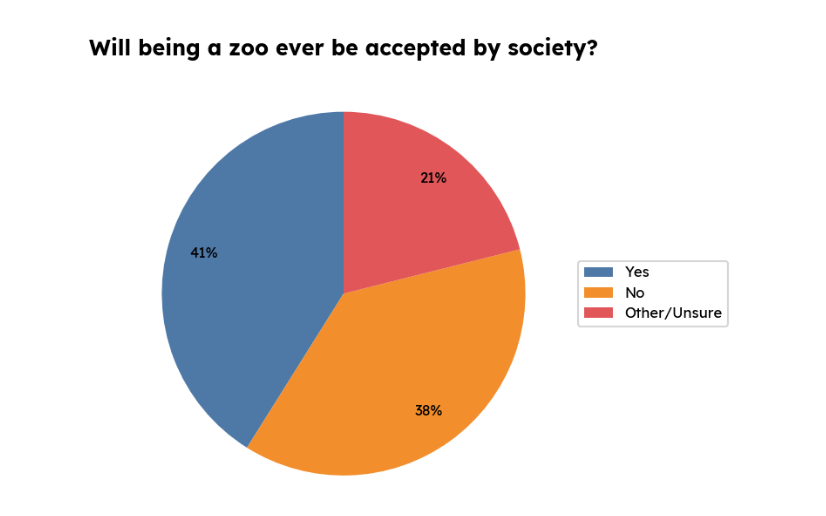
We asked whether or not people thought that at some point we were going to get zoo acceptance. And, for the most part most people think at some point we will, although it's REALLY close. 41% said yes, with 38% saying no, and 21% being undecided. Obviously, as an activist, I'd love to see that number go up. Of the people that said other, many were optimistic but didn't want to say yes, some were pessimistic but didn't want to say no. Overall, even though there's a lot of hope out there, we haven't totally convinced people. This is another one that I think is going to be really interesting to track as we go. I think this is really the most direct measure of our "success" as activists. The higher the percentage of people that believe, the better we're doing at giving people something to believe in.
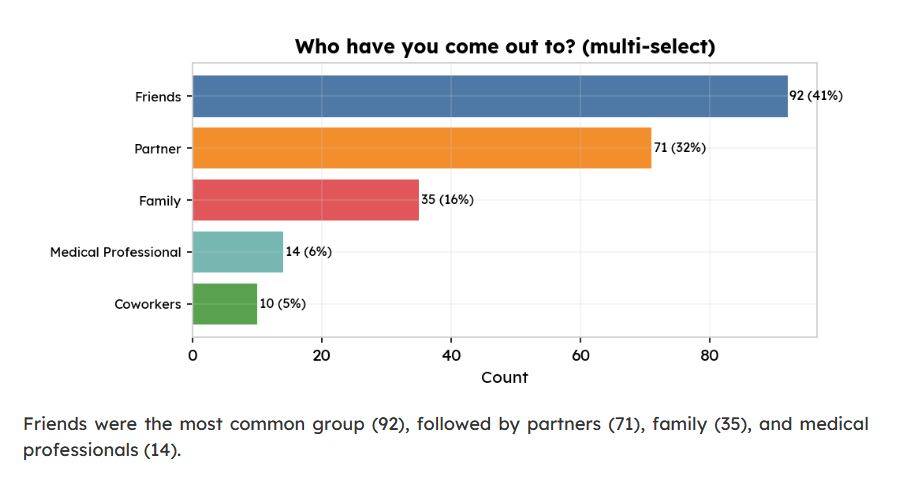
This one was fairly surprising to me as well. people who took this survey have come out to at least one family member. Maybe it's just because my relationship with my family isn't like that, but it's awesome to see that there are people out there who feel confident enough to take that risk, and hopefully those conversations ended with support. people have come out to a partner, and people have come out to some friends. I do think having at least one non-zoo friend you can talk to about all this is really cathartic, although far be it me to tell people what they should or shouldn't be doing. Coming out is hard and can be really dangerous, so don't do anything that'll get you in trouble, but as someone with some friends that know, it is very cool!
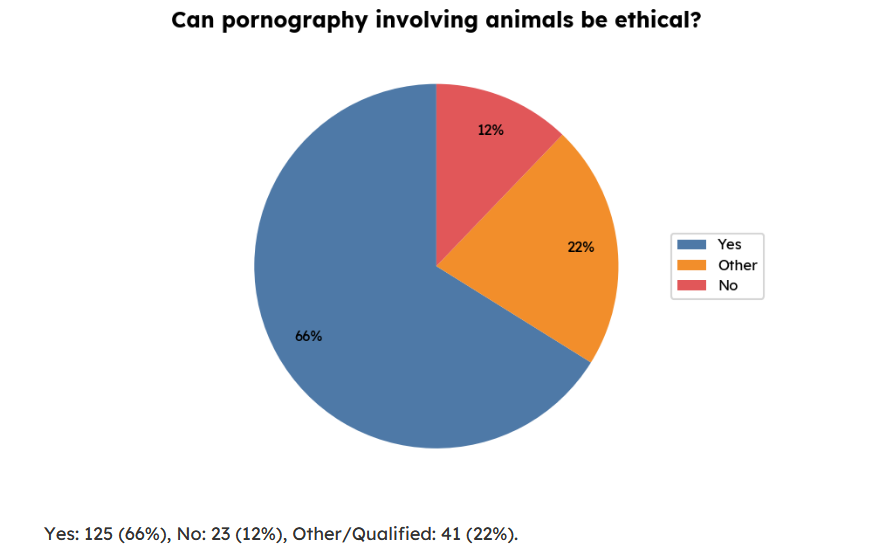
Alright, so I've been someone that's gone out of my way to defend the concept of bestiality. I personally think that while yes filming it does introduce ethical hurdles that don't exist otherwise, that doesn't preclude it from being okay. 66% of respondnts said that porn involving animals can be ethical, with only 12% saying that it's never ethical, and 22% being in the middle, usually with reservations. That said, it's cool to know that my view point is something that's generally consistnt in the community, and it might influence some of the content we do in the future.
Okay, that made it sound like we're going to release porn, that's not what I meant. But, maybe we'll do more interviews or more articles on that world, because I do think that it would be cool to loop some of the people who are consuming that content into the larger zoo community.
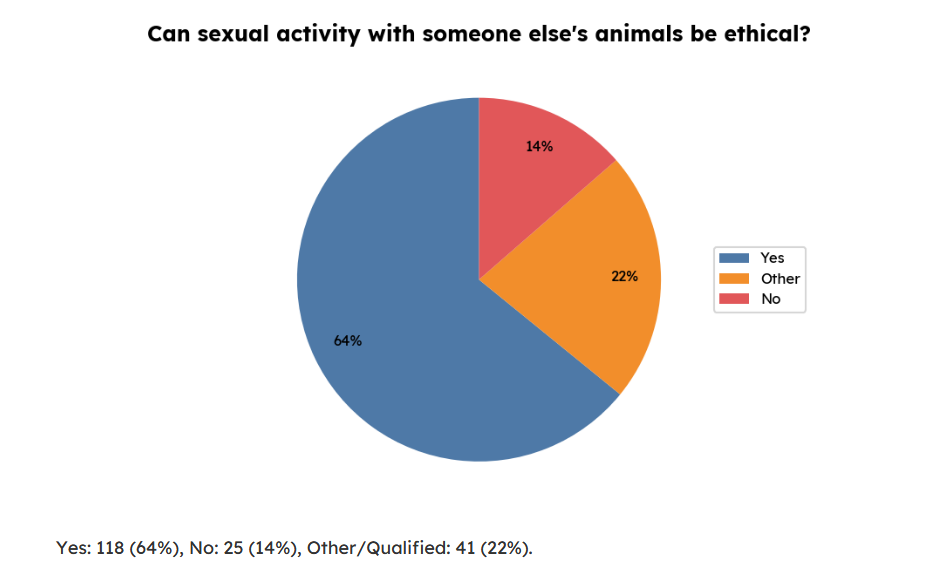
This one I also found really interesting. I think there's a really big conversation to be had about the idea of "fencehopping". We've published on it in fact! I think there's an interesting level of disrespect that you give to animals when you say that ownership to a different human precludes them from being able to have sex with someone else. To me, that feels like a very strange byproduct of the idea of "ownership" to animals which I'm uncomfortable with. But, 14% of respondnts disagree fully and say that any relationship with another person's animal is always unethical, and another 22% feeling generally unsure about it. The majority say that it can be okay, but I'm just somewhat surprised how big the no's and other's are.
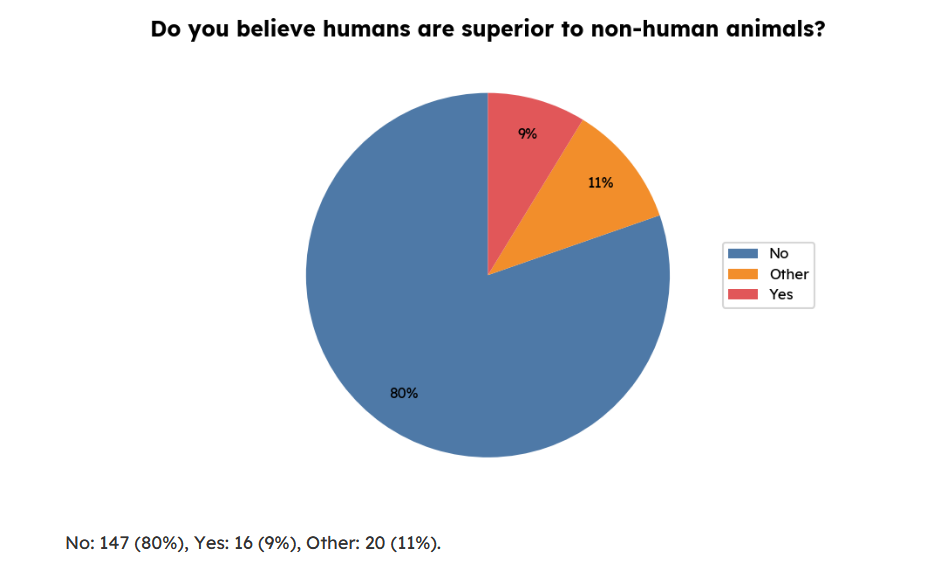
This one is pretty nice to see. We asked whether people thought humans were superior to non-humans, and 80% of respondnts said no. Which is awesome, because it shows just how much we care about animals. I'm sure if you asked the general population that number would probably be close to totally reversed. 9% of people said that we are in fact superior, and 11% said other, with the majority of the others being "in some ways", which I think is also a fair read in that we are the dominant species of the planet, much to the dismay of the planet.
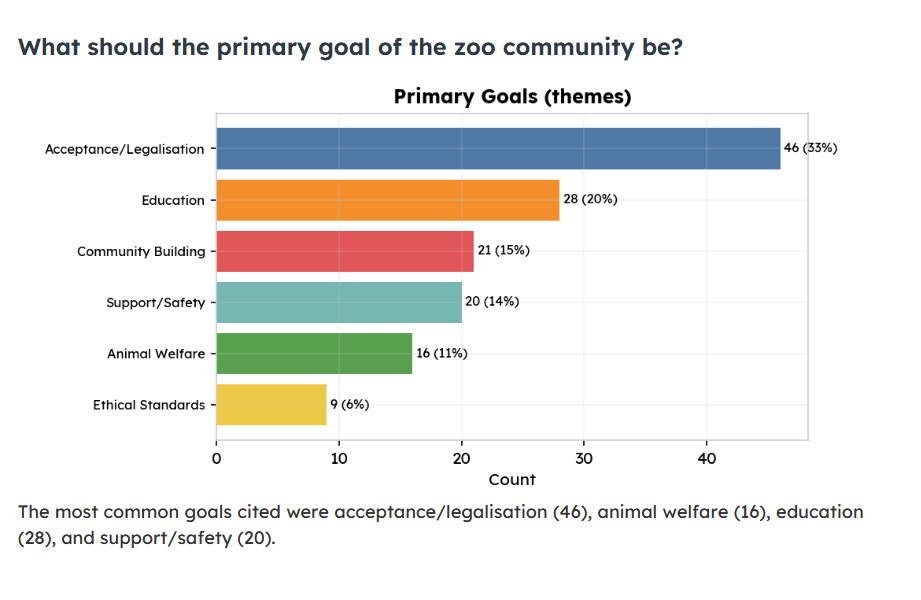
Last but not least, we asked people what the primary goal of the zoo community should be. This was an open ended question with a text block people could fill in, but we separated it down to categories. And honestly, I feel like this is a really good showing for where my personal priorities are too. 33% of people said the most important thing was acceptance, which makes sense. 20% said education, and 15% said community building. These would probably be my top 3 as well. Not that the others aren't still VERY important, but I think that those things can help to expand to the other things if we do really well at them. I think this is the thing that is most telling towards what people want to see. We know that people want to see acceptance pushes, that they want to be educated, and that they want to have a strong community. So, if we focus on those things, then we can see the most results with the general zoo community. I would say also it would be cool to change these values as different things get achieved. So, for instance, once the community is healthy and nice and big, then we can focus more on things like greater animal welfae. If we create good education, we can do so cognizantly of ethical standards. And so on and so on.
Anyway hey! If you made it here, wow! You're a fucking nerd! But hey, this took probably 4X the time a normal article takes to write, so hopefully somebody sees this.
I really love numbers like this. I think we can do so much with this data. And, I would love to do this again. Maybe annually, or bi-annually? For sure, we're going to be doing another Census soon, and then hopefully we'll be able to publish another article with the new data either at the end of this year, or the start of the next one. We'll start spreading that soon, so keep an eye out! If there's anything you thought of while reading this that you would love to know about the community, reach out to us and let us know and we might add it to the census before it goes out! I know there's definitely some stuff that I want to see next time.
Thanks for reading, now go outside!
Article written by Tarro (March 2026) and data collected by Aster (2024)
Find them at https://twitter.com/hereforthezoo
Questions, comments or concerns? Or, have things you want to see in the next Census? Check out https://join.zooey.pub