
Why?
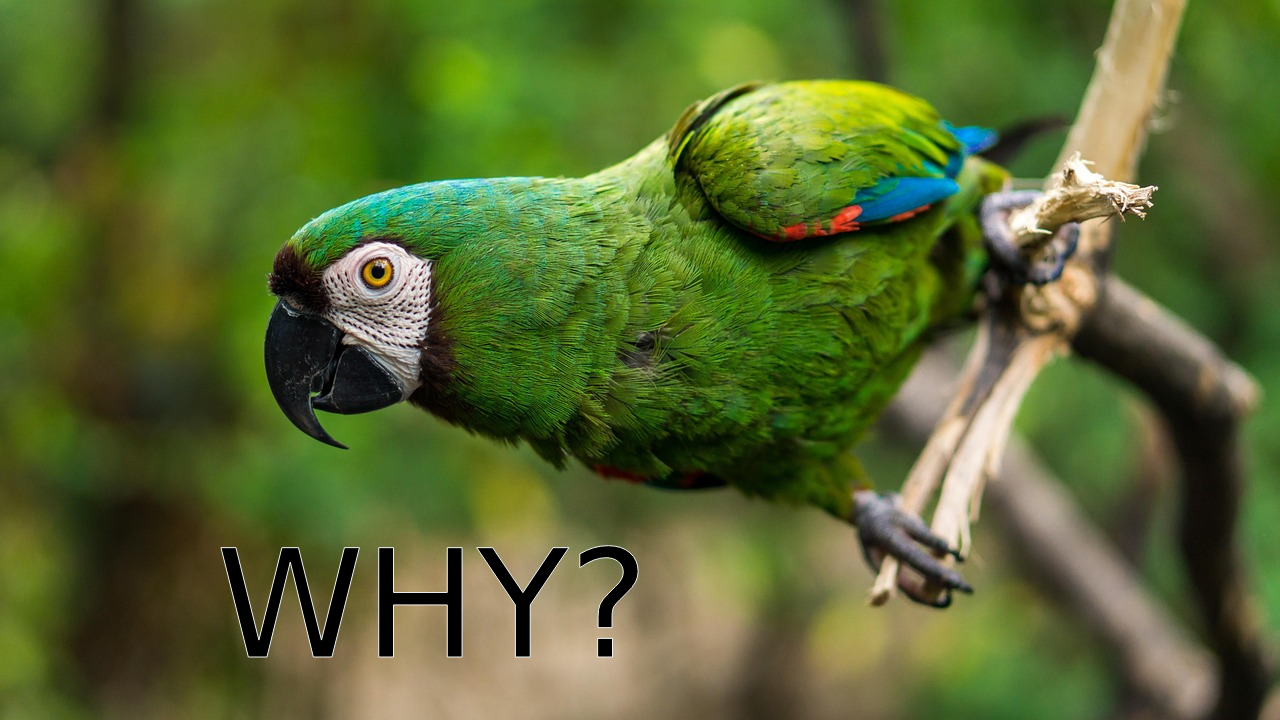
Have you ever talked with a child during that precious time between when they've realized just how little they understand, and before they've decided they know everything? It's a fascinating time. Our brains take in so much information to formulate who we are and what we believe in during those times. Kids want to turn over every rock, look behind every door, they want to know everything. The favorite question of a kid around this age is a simple one. "Why?"
Not just why of course, but I'm using it as a stand in for many other questions such as "how?" or "so?" This question comes much to the despair of the adults in their lives who are left with the responsibility of actually answering that question. It's hard to always have the time to research what the actual answer to that question is, especially when it comes out unprompted and unexpectedly. Sometimes the question ends up easy. Why does the sun come up? Because the earth is spinning. Why do worms live in the ground? Because they eat the nutrients in the soil. But the tricky thing about the question "why" lies mostly in its vagueness. throw out of your depth second or third "Why?". And it's a question that has essentially no satisfactory end point. If you ask me what day it is, it's Thursday at. . But when you ask why, there's always more to ask. And it a question that .
Let me give you an example. If I asked you why it rained, you could probably tell me it has to do with evaporation and clouds getting numerous and heavy and then it starts to rain. But why does that happen? Like, why does every cloud not rain all the time? Why do clouds gather and combine? Why does it create thunder and lightning? Maybe you can answer some of those questions too, but what about water makes it so that it can go through this chemical change from a solid to a gas to a liquid? What's the thing that's holding water molecules together? Why do they not just turn into one huge droplet?
Maybe you can answer every single one of those questions. You're a meteorologist or physicist or something like that. But can you answer every question about everything on the planet? Chances are the answer is likely no. And if it's yes, shoot me a DM so we can figure out this whole world peace thing. But, you don't need to be that smart. You can live through a million rainstorms and not really need to explain how they function. They just are.
And yet, when it comes to zoosexuality, this feels like the game that we're playing. We can explain why zoosexuality isn't harmful, but the response we get is rarely a positive affirmation of understanding. Much more often it's a push to go deeper. It's a why. With another one behind it too.
It goes something like this. We'll say animals can consent, they'll ask why. We'll explain that animals have autonomy and can express the things they like or dislike, they ask "so?". We explain that animals actually seek out and enjoy sex, they ask "how?".
The thing is, when people try and talk with us coming from the perspective of someone that wants to argue, they don't actually want to ask the question in an effort to learn. Unlike the children who ask questions because they want to know the answer, these people ask questions because they're trying to discover a lack of knowledge. They want to prove that the answer they already have is correct by tearing down any other perspectives that might be out there.
It's a pretty effective tactic honestly. When a zoo has to say that they don't know the answer something, it "proves" to these people that all zoos only care about the sex with animals part, and everything else in front of that is just a shield. And it doesn't matter how much of an expert you are. When it comes down to this topic, so much of it just hasn't been researched even. Nobody's cared to hook a dog up to an EEG while giving them a handie to see how much they really enjoy it. All we have is our anecdotal experiences.
I don't really understand how rain works. I couldn't answer most of the questions I pitched before. But I know that if I go outside when it's raining, I'm going to get wet. I know that when the clouds get dark and grey it's way more likely it's going to start raining. I know if there's thunder and lightning that I should avoid standing in an open field. I know that just like the rain comes, eventually it goes away and we're left with a clear, bright sky. Does it matter that I can't answer the more specific questions? I don't think so. I think I could say "I understand rain and what it is" and not have that be a false statement.
I also don't know every possible thing about dogs. I know a lot, I'd like to learn more. But I can't read a dog's body language like it's a book. I can't explain whether or not he actually "loves" me in the same way that I love him. I don't fully know if I could say whether he seeks out sex because he feels an instinctual drive, or because it feels good. Or if those are the same thing. And yet, I'm also extremely confident in the relationship that we have and the actions we take together. I'm not in the slightest worried that he secretly hates sex for the same reason I'm pretty sure that next time it rains it's not going to be one big drop, even if I don't know how to explain it.
And I think that's good enough. There's a lot of value in asking the big hard questions, and I certainly hope we do keep asking why. But don't let some idiot tell you that you don't know what rain is just because you aren't a meteorologist. You don't have to be. Sometimes the answer to "why?" Can be "I don't know, but let's find out." And that's okay. Not like it's going to stop raining any time soon.
Article written by Tarro (September 2026)
Find them at https://twitter.com/hereforthezoo
Questions, comments or concerns? Check out our Matrix server! https://join.zooey.pub