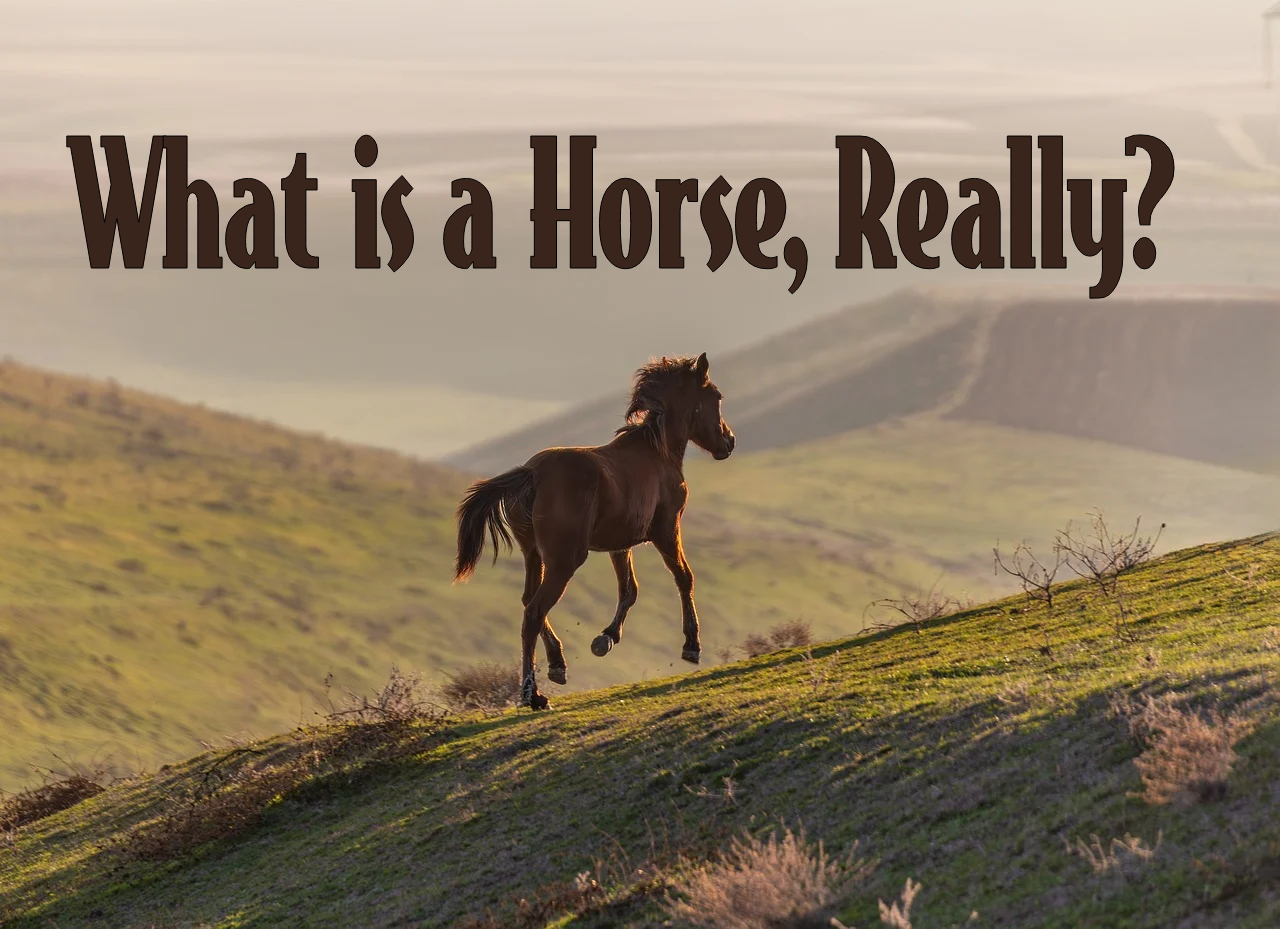
What Is a Horse, Really?
Horses 101
There is a strange problem with trying to write a Horses 101 article: where do you actually start?
Most introductions to horses begin with what humans do with them. Riding, training, grooming, racing, working. Maybe anatomy and breeds if you want to get technical about it. But none of those things are really the horse. Riding, for example, is something we put on top of the horse. Quite literally. A horse does not stop being a horse because nobody rides them, and a horse standing in a field doing absolutely nothing useful to us is no less complete than one carrying a rider.
So maybe Horses 101 needs to start somewhere else. What is a horse when we aren't asking them to do anything?
At the simplest level, they are large social animals that have spent thousands of years living alongside us. But even that description feels inadequate once you actually spend enough time around them. A horse notices things. Their ears turn toward sounds you haven't heard yet. Their attention shifts before you know what caught it. They smell you, watch you, and move closer or move away. Sometimes they seem intensely interested in what you're doing, and sometimes you may as well not exist.
And, importantly, they have the option of leaving. At least they should.
I think that matters more than we often give it credit for. Humans have an enormous amount of control over domestic horses. We decide where they live, what land they have access to, what other horses they live with, when they eat, whether they are ridden, how they are trained, and sometimes even when they are allowed to move. Yet underneath all of that management is still an animal making choices of their own.
That is probably the first thing worth understanding about horses. They are not equipment with personalities. They are individuals.
A horse is a social animal
You will often hear horses described first as prey animals. That is true, and it explains quite a lot about them, but I don't think it should be the first thing that defines them.
Horses are also intensely social animals. Given the opportunity, they form relationships with other horses. They have horses they prefer to spend time with and others they would rather avoid. They stand together, travel together, groom each other, rest near each other, and keep track of what the others are doing.
Their social lives are not just constant arguments over who is in charge. There is conflict, obviously. Anyone who has watched horses for long enough has probably seen pinned ears, threats, chasing, or somebody being told rather clearly to move. But most of their lives aren't spent fighting. A great deal of horse communication is quiet enough that you can miss it if you are waiting for something dramatic to happen.
A head turns. One horse moves a few feet, and another follows. Two stand together while a third chooses somewhere else. A horse walks away and, sometime later, comes back. None of that looks especially exciting from the outside, but it is still part of the social world they are constantly navigating.
This is part of why I think we sometimes misunderstand horses. Humans like behaviours that are easy to label: dominant, submissive, aggressive, and friendly. The horse doesn't necessarily organize their entire life into categories that are convenient for us. They have relationships, and those relationships matter.
Yes, they are prey animals
Of course, the prey-animal part still matters. A horse's best defence against danger is usually getting away from it, and they are built astonishingly well for that. They are large, fast, extremely aware of movement around them and capable of reacting long before the human standing beside them has figured out what the problem is.
That means a plastic bag in a hedge can occasionally become an event of enormous importance. It also means that trapping a frightened horse can make a bad situation considerably worse. When escape isn't available, horses can defend themselves. They can kick, bite, strike, and move several hundred kilograms of body mass very quickly.
That isn't the horse being malicious. They're a horse being a horse.
But I think there is a danger in taking the prey-animal explanation too far as well. Not everything a horse does is fear. Horses investigate things, play, become curious, form routines, and seek each other out. They can become extremely interested in what a human is doing for reasons that have very little to do with survival. Sometimes a horse comes over because you have food, sometimes because whatever you're carrying is apparently the most interesting object they have seen all day, and sometimes, inconveniently for anyone trying to reduce their behaviour to a simple formula, they seem to come over because they wanted to be near you.
Fear explains some horse behaviour. It does not explain the horse.
They experience a different world
One of the stranger things about knowing horses is slowly realizing that you aren't standing in quite the same world they are. Obviously, physically, you are, but the information reaching them is different.
Their eyes sit on the sides of their head and give them an enormous view of what is happening around them. Their ears can move independently toward sounds. Their noses are constantly gathering information we barely notice. A horse may stop and look toward something long before you can see it. Their ears may lock onto a sound you cannot hear. They may spend a surprising amount of time investigating your coat because apparently you have become interesting since yesterday.
Smell in particular is easy for us to underestimate. Horses investigate each other with it. They investigate people with it. They investigate manure, objects, food, and unfamiliar places. Then there is the flehmen response, where a horse raises their head and curls their upper lip. It looks ridiculous, but it is also a way of investigating particular chemical information more closely.
Even touch isn't quite what we experience. A horse can feel a fly land on their skin. Think about that for a moment, and then think about how casually we sometimes grab, push, pull, or pat them.
They are not numb simply because they are big. Size and sensitivity are not opposites.
Their ears are not subtitles
This is probably one of the biggest mistakes people make when trying to learn horse behaviour. We want a dictionary.
Ears forward means this. Ears back means that. Tail swishing means this. Licking means that.
There are patterns worth learning, of course. Ears pinned flat against the head deserve your attention. A tense body deserves your attention. A horse suddenly trying to create distance from you deserves your attention. But behaviour needs context.
Ears move constantly because horses are listening constantly. A tail can swish because a horse is irritated, but it can also swish because there is a fly. A horse moving away from your hand could dislike what you're doing. They could also be moving toward another horse, toward food, or simply somewhere they wanted to be.
You have to look at the whole animal and, often, at what happened immediately before the behaviour. This is where actually knowing an individual horse becomes important. You start learning their normal. You notice when something is different. You learn which expressions belong to that horse instead of trying to fit every horse into the same diagram.
There are certainly signals humans should know for safety, but a horse isn't a dashboard full of warning lights. They are communicating in a body.
Choice tells you a lot
This brings me back to the horse being able to leave.
A great deal of traditional horse handling is built around controlling where the horse goes. Sometimes that is unavoidable. A horse cannot be allowed to wander onto a highway in the name of personal freedom. Veterinary treatment sometimes has to happen whether anybody is particularly enthusiastic about it. Fences exist for a reason.
But within those necessary limits, choice can tell us an enormous amount.
If I walk toward a horse and they walk away, that means something. Maybe not something dramatic. Maybe they simply don't want me right now. If they walk away and then return, that means something too. If I stop scratching them and they reposition themselves under my hand, that is information. If they repeatedly choose to stand near me when nothing is restraining them and I have nothing they need, that is information as well.
We don't have to pretend that we can translate these things perfectly into human sentences. I actually think that makes the observation more interesting. Instead of deciding, The horse did X, therefore the horse feels Y, you can ask what the horse chose, what changed when you changed what you were doing, whether they sought more contact or less, and what happened when you stopped asking.
There is a difference between tolerance and participation.
That difference matters to me.
Getting close to one
If someone who has never spent much time with horses asked me how to become close to one, I don't think I would start with training. I'd probably tell them to spend time there and not do very much.
Watch the horse when they aren't being asked to perform something. See who they stand with. See how they react when another horse approaches. Notice whether they tend to walk straight toward people or hang back and investigate from a distance. Let them smell you. Find somewhere they like being scratched.
And learn when to stop.
That last part is probably more important than it sounds. Humans have a tendency to think closeness means doing something: petting, grooming, riding, teaching, or playing. But some of the closest moments you can have with a horse don't really look like anything.
You can stand beside one while they eat. Sit somewhere nearby while they rest. Walk through a pasture and discover someone has decided to follow you. Put your hand against their neck and leave it there. Nothing impressive happens. There is no performance, and there may not even be much interaction.
You're just there together.
I think humans sometimes struggle with that kind of relationship because there is nothing to accomplish.
The horse doesn't.
They are also very large
This is the point where romantic descriptions of horses need a little reality added back in. Horses are powerful animals. Very powerful animals.
Even a relatively small horse can weigh several hundred kilograms. They don't need to be aggressive to hurt you. A horse moving their head suddenly can hit you. A foot placed accidentally on yours can do a surprising amount of damage. A frightened horse trying to escape can move through a human without much difficulty, and a kick can kill you.
None of that means you should be frightened every time you stand next to one. It means you should respect what they physically are.
Learn where their legs are. Don't trap yourself between a horse and something solid. Don't assume a horse is incapable of reacting just because they are normally quiet. Give them somewhere to go. And perhaps most importantly, pay attention when behaviour changes.
A horse suddenly becoming difficult about something they normally accept should make you curious before it makes you angry. Pain changes behaviour. So does fear. So does confusion. So does having had enough.
The behaviour is information before it is a problem to solve.
A horse does not exist to be ridden
This might be the most obvious statement in this entire article, but it is surprisingly easy to forget.
Horses existed before anyone climbed onto one, and an individual horse does not require riding to justify their existence today. This doesn't mean riding is inherently wrong. It means riding belongs in the category of things humans do with horses, not in the definition of the horse itself.
The same applies to racing, showing, pulling carts, jumping fences, doing tricks, or anything else we have taught horses to do. Those things can tell you something about human culture, but they don't tell you what the horse is.
A horse standing in a pasture is not a riding horse currently going unused. They are simply a horse standing in a pasture. That distinction sounds almost stupidly obvious, but it becomes more interesting when you start noticing how much of our language around animals is based on their usefulness to us.
A working horse. A broodmare. A riding horse. A racehorse. A companion horse.
All are useful descriptions in the right context, but they describe the role we have assigned. The horse underneath all of those words is still an individual animal with a life happening independently of that role.
We have been fascinated with them for a very long time
Humans and horses have a strange history together. We used them for transportation, agriculture, war, and sport. They allowed humans to move farther and faster than our bodies otherwise could, and they became symbols of wealth and status because owning a good horse could fundamentally change what a person was capable of doing.
But horses also became something more than equipment remarkably often. They appear throughout human mythology: Pegasus, Sleipnir, Epona, and Centaurs. Different cultures looked at the horse and saw freedom, power, fertility, war, travel, death, wisdom, and sometimes a bridge between worlds.
There is probably no single reason for that, but I don't think it is difficult to understand if you've stood quietly with one.
There is an odd combination of characteristics in a horse. They are immensely powerful but can be extraordinarily gentle. They are domestic animals, but much of their behaviour still feels distinctly outside the human world. They can carry us, work beside us, and learn astonishingly specific things from us, while remaining very obviously another species with priorities of their own.
And if a horse genuinely chooses your company, there is something deeply satisfying about that.
Because they didn't have to.
Not every horse is the same horse
Maybe this should be obvious too. It often isn't.
People talk about horses as though there is a standard horse hidden underneath different colours and breeds. There isn't.
There are tendencies. Breeding matters. Past experience matters. Age matters. Health matters. The environment matters. But individual personality matters too.
Some horses seem endlessly curious. Some are cautious. Some want to investigate every object you carry. Some are perfectly happy to let another horse do the investigating first. Some seek enormous amounts of human interaction, while others are much more selective.
And even the same horse can change enormously depending on context. A horse with their herd may behave differently from the same horse alone. A horse at home may behave differently somewhere unfamiliar. A horse in pain may behave unlike themselves entirely.
Even relationships change.
That is another reason I hesitate when people try to explain horses entirely through instinct. Of course instinct matters. Hormones matter. Evolution matters. But those things are part of an animal, not a substitute for the individual.
A human being is influenced by biology too. We don't therefore conclude that personality doesn't exist.
I don't think horses deserve a simpler explanation merely because they cannot argue with ours.
So what is a horse, really?
I don't know that Horses 101 can actually answer that. Maybe it shouldn't.
The more time you spend with horses, the less satisfying the simple descriptions become. Prey animal. Herd animal. Domestic animal. Livestock. Companion. Athlete. All true in some sense, and none complete.
Perhaps the better starting point is simply recognizing that there is someone else standing there. Not a human in a horse's body, not a mystical creature who understands everything we feel, and not a biological machine reacting blindly to whatever stimulus happens to come next.
A horse.
An animal experiencing the world in a way that overlaps with ours without being identical to it. They have their own relationships, preferences, fears, and history with the people and animals around them. They also have their own body, which they experience from the inside while the rest of us can only observe it from the outside.
That last part matters. The horse is the expert in being the horse.
We can study them. We can learn their behaviour. We can become better at noticing what they are telling us. But I don't think the goal should be to reach a point where we believe we have completely figured them out. The goal should probably be the opposite: to become good enough at paying attention that we notice when the horse in front of us doesn't fit the explanation we already had.
Because before the saddle, before the training, before the work, before the mythology and before whatever role we have decided they should play in our lives, there is an animal standing there with a life of their own.
Maybe that is the real Horses 101.
Start with the horse.
Article written by Mares² (October 25th 2026)
Questions, comments or concerns? Check out our Matrix server! https://join.zooey.pub