
We didn't ask them
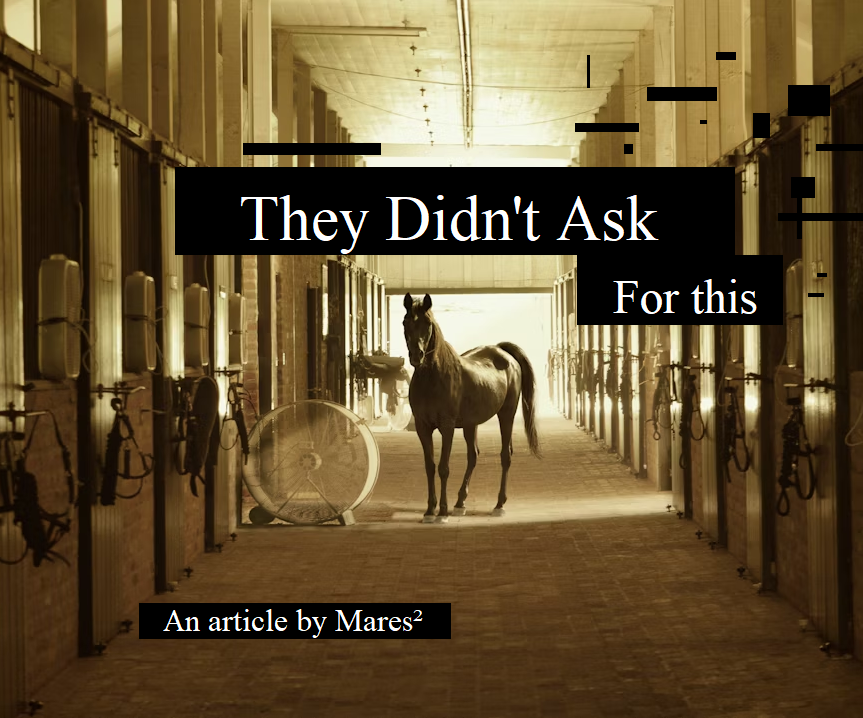
Most people who keep horses will tell you they love them. They mean it sincerely. The spend more on feed and farrier bills than their own groceries. They wake before dawn in winter to break ice from the water troughs. They know their horse's moods, their preferences, their particular way of sighing when something is wrong. And yet, for all that love, there is a question that rarely gets asked directly: did the horse get a vote?
Not in the abstract philosophical sense. In the practical, daily sense. Did the horse choose to live here, in this stable, with this person, doing this work? The answer, in every case, is no. And that matters more than the horse world tends to acknowledge.
The Weight of Total Control
There is power, and then there is the kind of power that shapes an entire existence. Humans hold the latter over domestic horses. We decide where they live — whether that is a forty-acre pasture or a twelve-by-twelve stall. We decide who they live with, or whether they live with anyone at all. We control when they eat, what they eat, and how much. We determine whether they reproduce, and with whom. We choose the work they do, the pace at which they do it, and what happens when they can no longer perform.
This is not a criticism in itself. It is a description. And it is worth sitting with the full weight of what that description means, because the horse world has a tendency to soften it. Words like partnership and bond and trust are used constantly, and often genuinely felt — but they can also function as a way of not looking too directly at the structural reality underneath. A partnership between parties with radically unequal power, where one party controls every material condition of the other's life, is a very specific kind of partnership. It deserves to be named honestly.
The honest name is custodianship. Humans are not partners with horses in any meaningful symmetrical sense. We are custodians — and custodianship, if it is taken seriously, is not a comfortable role. It comes with obligations that go beyond affection.
An Inheritance Nobody Chose
Here is the complication that makes this harder than a simple critique of ownership: the horse standing in your field did not choose domestication, but neither can they meaningfully exist outside of it. Equus ferus caballus — the domestic horse — is the product of roughly six thousand years of selective human intervention. Their temperament, their physical form, their social behaviour, their relationship to humans — all of it has been shaped by generations of choices made entirely by us. We bred them to be manageable. We bred them to be willing. And then, having done all of that, we sometimes point to their willingness as evidence that everything is fine.
This is the domestication trap. The adaptation of horses to human management is not the same thing as endorsement of it. An animal that has been bred across dozens of generations to tolerate confinement, accept handling, and respond to human cues is not expressing a preference. They are expressing the cumulative result of an enormous amount of human selection pressure applied without their input over an enormous amount of time.
This does not mean that individual horses cannot have genuine preferences, or that positive relationships between horses and humans are impossible. It means that when we use a horse's apparent compliance as our primary evidence that we are doing right by them, we are using a circular argument. We made them this way. Their adaptation is partly our doing. We cannot then treat that adaptation as independent confirmation that our choices are justified.
What we owe, instead, is something more honest — an acknowledgment that domestic horses exist in a situation they did not create and cannot leave, and that this creates a specific kind of obligation on our part.
Necessity, Preference, and the Uncomfortable Middle
Not all human intervention in a horse's life carries the same ethical weight. A useful way to think about this is a simple spectrum.
At one end sits genuine welfare necessity — veterinary treatment, emergency intervention, management decisions made because the horse's health or safety depends on them. These are cases where the human acts on behalf of the horse, even when the horse would prefer otherwise. The justification here is strong and relatively straightforward.
At the other end sits pure human preference — breeding decisions made for aesthetic reasons, training methods chosen for efficiency rather than the horse's experience, disciplines that prioritise spectacle or tradition over equine wellbeing. These are cases where the horse bears the cost of a human desire. The justification here is thin, and ought to be scrutinised.
In between sits the large and uncomfortable middle ground where most of what humans do with horses actually lives. Recreational riding. Competitive sport. Working roles. Breeding programs. These activities are not purely necessary, but nor are they purely self-indulgent. They exist in a complex space where human benefit, genuine care, tradition, economics, and equine experience are all tangled together.
The ethical question is not whether humans should stop keeping horses. It is whether we are applying honest scrutiny to where our activities fall on that spectrum, and whether our justifications are proportional to what we are asking. The higher the cost to the horse — in discomfort, restriction, stress, or loss of agency — the stronger the justification needs to be. Desire, tradition, and economic value are not nothing, but they are also not sufficient on their own when the stakes are high enough.
Most horse people do not ask this question rigorously. Not because they are cruel, but because the systems they operate within do not require it. Competitions reward results. Traditions carry authority. Markets reward performance. None of these systems have a strong structural incentive to ask whether the horse is genuinely okay with what is being asked of them.
A Harder Standard
None of this is an argument for the abolition of horse-keeping. It is an argument for honesty — a more demanding kind of honesty than the horse world typically asks of itself.
That honesty starts with dropping the language that obscures the power differential. Horses are not our partners in the sense that implies symmetry. They are animals in our care, in a situation shaped entirely by human decisions, and they deserve the kind of rigorous ethical consideration that situation demands.
It continues with genuine curiosity about what horses are actually communicating — not just whether they are resisting, but whether they are willing. As the previous piece on silence and consent explored, the absence of protest is a low bar. Horses are expressive animals. They communicate through posture, tension, engagement, and hesitation. The responsibility is on humans to read more carefully than habit tends to encourage.
And it requires applying the proportionality test honestly — asking, for each thing we do with and to horses, whether the benefit justifies the cost, and whether the justification is genuinely about the horse or primarily about us.
This is not a comfortable process. It will, if done honestly, implicate most of the horse world to some degree — including the people who love their horses most. That discomfort is not a sign that the question is wrong. It is a sign that the question is worth asking.
Horses did not ask to be here, in these stables, in these fields, doing this work, living lives shaped by human decisions made long before they were born. The least we can offer in return is the willingness to take that seriously.
Article written by Mares² (March 2026)
Questions, comments or concerns? Check out our Matrix server! https://join.zooey.pub